
Carboxylic Acids & Fischer Esterification
Understand acid structure, carboxylate stability, and equilibrium-driven ester synthesis.
1. Understand the Concept
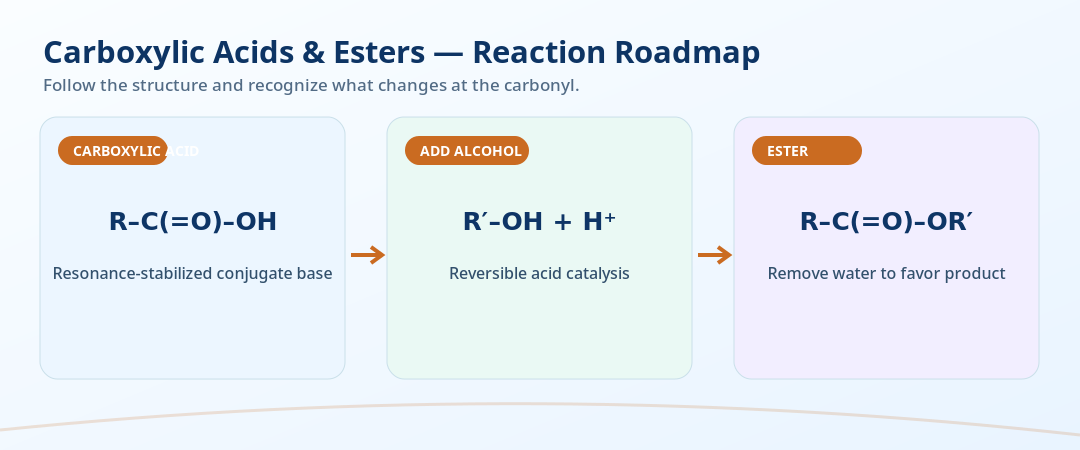
Carboxylic acids contain R–C(=O)–OH and are substantially more acidic than ordinary alcohols because the conjugate carboxylate is resonance-stabilized. With an alcohol and strong acid catalyst, they reversibly form esters; excess alcohol or removal of water can favor products.
Learning outcome: Recognize carboxylic acids, compare acidity qualitatively, and predict products of Fischer esterification and hydrolysis.
2. Follow a Consistent Strategy
- Locate the R–C(=O)–OH functional group and identify its carboxylate conjugate base.
- For esterification, choose an alcohol and an acid catalyst.
- Replace the acid –OH with the alcohol-derived –OR group in the ester; track water as a byproduct.
- For reverse hydrolysis, consider excess water and acid catalysis; do not treat equilibrium as one-way.
3. See the Chemistry
4. Work Through Examples
Fischer esterification
CH₃COOH + CH₃CH₂OH ⇌[H⁺] CH₃COOCH₂CH₃ + H₂O
Ethanoic acid and ethanol give ethyl ethanoate under acid catalysis; equilibrium conditions matter.
Acid–base reaction
CH₃COOH + NaHCO₃ → CH₃COONa + CO₂ + H₂O
Acetic acid protonates bicarbonate, releasing carbon dioxide and forming the carboxylate salt.
5. Avoid These Mistakes
- Assuming simple carboxylic acids are as reactive as acid chlorides to direct nucleophilic acyl substitution.
- Treating Fischer esterification as irreversible.
- Confusing the alkoxy oxygen in an ester with the carbonyl oxygen.
6. Review & Check Understanding
Why is acetate relatively stable?
The negative charge is delocalized across the two oxygen atoms in resonance contributors.
What product forms from methanoic acid and ethanol with acid catalyst?
Ethyl methanoate and water, in a reversible equilibrium.
7. Test Your Understanding
Try eight curated questions with explanations of every answer. You can repeat the set without creating an account.
Check your understanding
Eight carefully reviewed problems with feedback for each choice. Your answers stay in your browser.
Loading questions…