
Hemiacetals, Acetals & Protecting Groups
Learn why alcohol addition produces hemiacetals and how acidic conditions yield acetals.
1. Understand the Concept
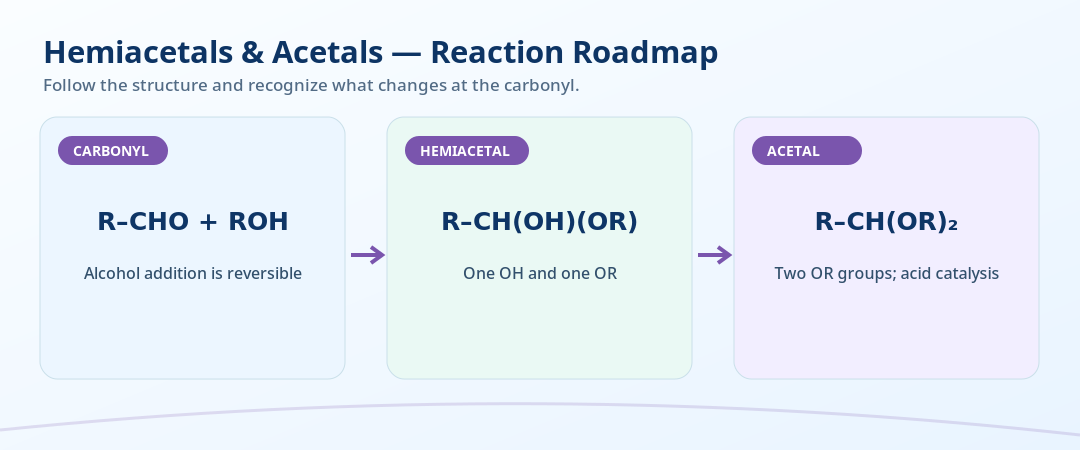
Adding one equivalent of alcohol to an aldehyde or ketone can give a hemiacetal or hemiketal, with OH and OR on the same carbon. With acid catalysis and further alcohol, an acetal or ketal can form with two OR groups. This chemistry is reversible and water removal often favors protection.
Learning outcome: Distinguish hemiacetals from acetals and connect reversible acetal formation to protecting-group use.
2. Follow a Consistent Strategy
- Identify the starting carbonyl and alcohol.
- Recognize a hemiacetal: OH and OR on the same original carbonyl carbon.
- Recognize an acetal: two OR substituents on that same carbon.
- For protection, use acid catalysis and remove water; for hydrolysis, use aqueous acid.
3. See the Chemistry
4. Work Through Examples
Hemiacetal formation
CH₃CHO + CH₃OH ⇌ CH₃CH(OH)(OCH₃)
The carbonyl carbon now has one OH and one OMe substituent.
Acetal formation
CH₃CHO + 2 CH₃OH ⇌[H⁺] CH₃CH(OCH₃)₂ + H₂O
The protected carbonyl bears two methoxy groups and no carbonyl π bond.
5. Avoid These Mistakes
- Calling a species with OH and OR an acetal instead of a hemiacetal.
- Claiming acetal formation is irreversible; its equilibrium is sensitive to water.
- Expecting acetals to hydrolyze readily in basic water; acetal hydrolysis is acid-catalyzed.
6. Review & Check Understanding
How many OR substituents are on a simple acetal carbon?
Two OR groups.
What conditions commonly remove an acetal protecting group?
Aqueous acid, which catalyzes hydrolysis back to the carbonyl.
7. Test Your Understanding
Try eight curated questions with explanations of every answer. You can repeat the set without creating an account.
Check your understanding
Eight carefully reviewed problems with feedback for each choice. Your answers stay in your browser.
Loading questions…