
Nucleophilic Acyl Substitution & Derivatives
Compare acid chlorides, anhydrides, esters and amides using the tetrahedral intermediate.
1. Understand the Concept
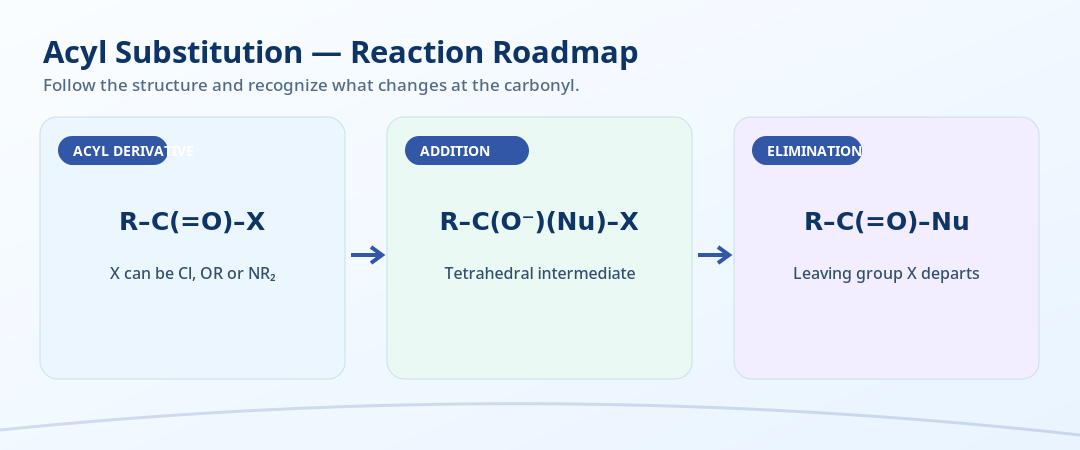
Carboxylic acid derivatives carry a group X on the acyl carbon: R–C(=O)–X. Nucleophilic addition gives a tetrahedral intermediate; reformation of the C=O group expels a suitable leaving group. A useful introductory reactivity trend is acyl chlorides > anhydrides > esters ≈ carboxylic acids > amides, with conditions and leaving-group protonation affecting outcomes.
Learning outcome: Explain why nucleophilic acyl substitution usually replaces a leaving group and predict products for common acid derivatives.
2. Follow a Consistent Strategy
- Identify the acyl compound and potential leaving group X.
- Identify the nucleophile (water, alcohol or amine) and any acid/base catalyst.
- Draw nucleophilic attack followed by a tetrahedral intermediate.
- Re-form C=O and remove X; complete proton transfers and account for the byproducts.
3. See the Chemistry
4. Work Through Examples
Acid chloride to ester
CH₃COCl + CH₃CH₂OH → CH₃COOCH₂CH₃ + HCl
The alcohol replaces chloride; a base is often added to neutralize the generated acid.
Ester aminolysis
CH₃COOCH₃ + NH₃ → CH₃CONH₂ + CH₃OH
Under suitable conditions an amide can form; ester aminolysis may require heating or excess nucleophile.
5. Avoid These Mistakes
- Confusing nucleophilic addition (aldehyde/ketone) with addition–elimination (most acyl derivatives).
- Assuming amide is the most reactive derivative because nitrogen is strongly basic; amides are resonance-stabilized and comparatively unreactive.
- Assuming every nucleophilic acyl substitution proceeds rapidly under room-temperature neutral conditions.
6. Review & Check Understanding
What happens after attack on an acyl derivative?
The tetrahedral intermediate collapses, restoring C=O and expelling an appropriate leaving group.
Which is generally more reactive to substitution, acetyl chloride or acetamide?
Acetyl chloride, which has a better leaving group and less amide-type resonance stabilization.
7. Test Your Understanding
Try eight curated questions with explanations of every answer. You can repeat the set without creating an account.
Check your understanding
Eight carefully reviewed problems with feedback for each choice. Your answers stay in your browser.
Loading questions…