
LAB REPORTING / SCIENTIFIC REASONING
Combining GC, IR, and Recovered-Mass Evidence
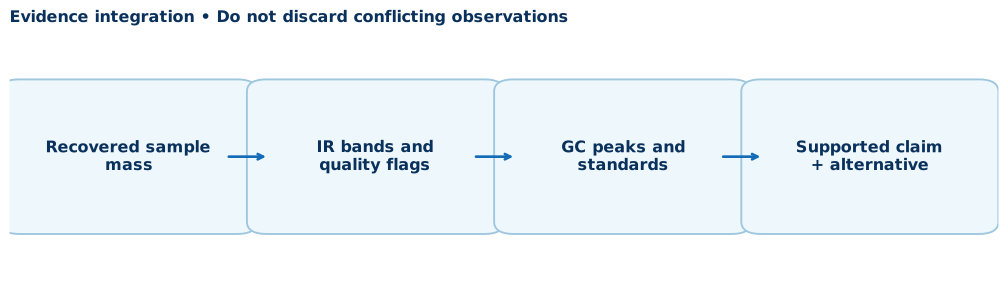
Compare observations from complementary techniques without hiding disagreements or overstating what one measurement proves.
1. Define the claim
Ask whether the product formed, which functional groups are present, whether a mixture is likely, and whether a quantitative yield claim is supported. These are different questions requiring different evidence.
2. Identify independent observations
Recovered mass indicates how much material was collected but not whether it is pure. IR supports functional-group assignments. GC provides method-dependent separation and detector response; peak identification and quantitative composition need standards and calibration.
3. Worked evidence conflict
Imagine a recovered liquid mass that appears too high, an IR spectrum retaining a broad O–H feature, and a GC trace with several peaks. Solvent carryover or unreacted starting material is plausible. The evidence does NOT justify reporting a pure product with >100% yield.
4. Plan the next test
Repeat drying/weighing, inspect raw IR background, run suitable GC standards, and compare replicate chromatograms. Choose the follow-up that most directly discriminates between the proposed explanations.
5. Write a claim-evidence-reasoning conclusion
State the claim, cite at least two measurements with units, explain what each supports, list a plausible alternative, and specify what additional evidence would change your conclusion.
Common interpretation mistakes
- Assuming higher recovered mass means more pure product.
- Treating matching GC retention as proof of molecular identity.
- Discarding contradictory results instead of investigating them.
Quick concept check
The recovered mass is unusually high but the IR and GC disagree with your expected pure product. What should you investigate?
Show answer and reasoning
First check sample contamination or retained solvent/reactant, and verify instrument quality. Report the disagreement honestly; do not claim a pure yield from recovered mass alone.