
Aldehydes & Ketones: Understanding the Carbonyl
Recognize carbonyl groups, name simple compounds, and predict relative reactivity.
1. Understand the Concept
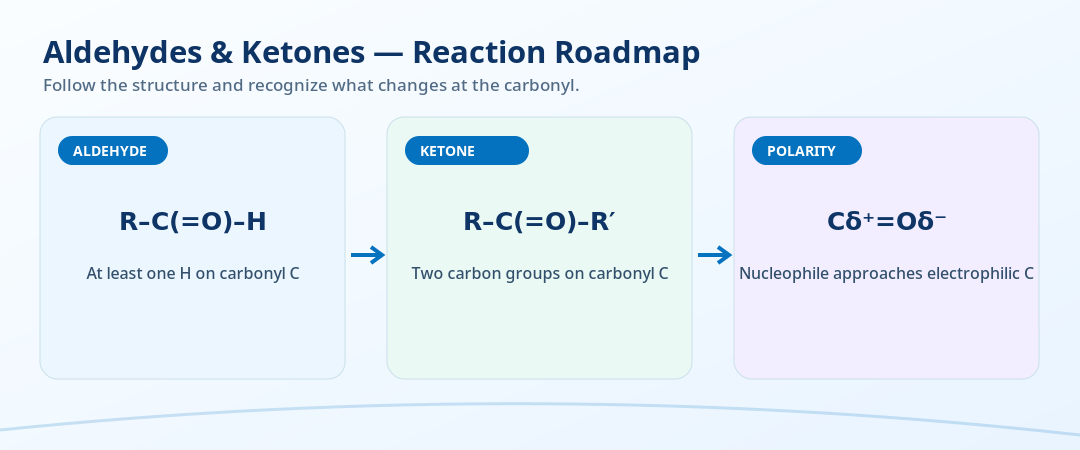
A carbonyl has a polar C=O bond. Oxygen is relatively electron-rich; the carbonyl carbon is electrophilic. Aldehydes have at least one hydrogen attached to the carbonyl carbon (R–CHO), while ketones have two carbon groups attached (R–CO–R′).
Learning outcome: Identify aldehydes and ketones, describe C=O polarity, and explain why aldehydes typically undergo nucleophilic addition more readily.
2. Follow a Consistent Strategy
- Locate the C=O bond and identify the atoms attached to its carbon.
- Aldehyde: the carbonyl carbon is bonded to H; ketone: it is bonded to two carbon groups.
- For nomenclature, use -al for aldehydes and -one with a locant for ketones.
- Explain reactivity using steric crowding and electronic effects; other groups can change the trend.
3. See the Chemistry
4. Work Through Examples
Recognizing a carbonyl
CH₃CH₂CHO is propanal, an aldehyde.
The carbonyl carbon is terminal and has a hydrogen attached.
Comparing addition reactivity
CH₃CHO (ethanal) versus CH₃COCH₃ (propanone).
Ethanal generally reacts faster with many nucleophiles because it is less sterically hindered and less alkyl-stabilized.
5. Avoid These Mistakes
- Calling any C=O-containing molecule a ketone; esters, amides and acids also have carbonyls.
- Assuming every aldehyde reacts faster than every ketone without considering additional substituents and conditions.
- Confusing an aldehyde carbonyl with a carboxylic acid carbonyl.
6. Review & Check Understanding
What makes a ketone different from an aldehyde?
A ketone has two carbon substituents at the carbonyl carbon; an aldehyde has at least one H there.
Which is usually more reactive toward simple nucleophilic addition, ethanal or propanone?
Ethanal, owing generally to reduced steric hindrance and greater electrophilicity.
7. Test Your Understanding
Try eight curated questions with explanations of every answer. You can repeat the set without creating an account.
Check your understanding
Eight carefully reviewed problems with feedback for each choice. Your answers stay in your browser.
Loading questions…