
E2 in Cyclohexanes: Trans-Diaxial Requirement
Understand why ring conformations control E2 elimination and how to recognize a productive chair.
The geometry required for cyclohexane E2
For a typical cyclohexane E2, the leaving group must be axial, and a neighboring β-hydrogen must also be axial on the opposite face. The bonds are then anti-periplanar, allowing the concerted elimination.
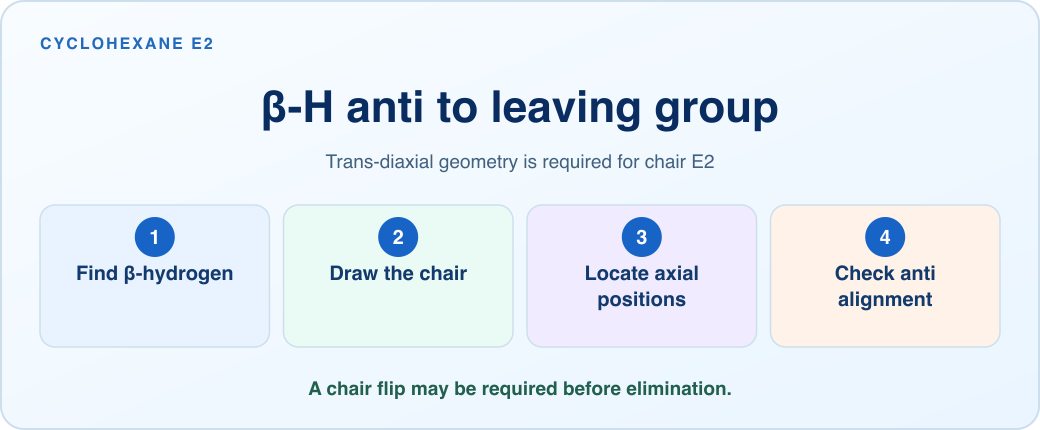
How to solve a cyclohexane E2 problem
- Draw an accurate chair and label the leaving group as axial or equatorial.
- If the leaving group is equatorial, consider the ring-flipped chair.
- Check the adjacent carbons for an axial β-H anti to the axial leaving group.
- Eliminate from an allowed β-position and draw the corresponding double bond.
- Check whether other ring constraints or conformational preferences change the likely product distribution.
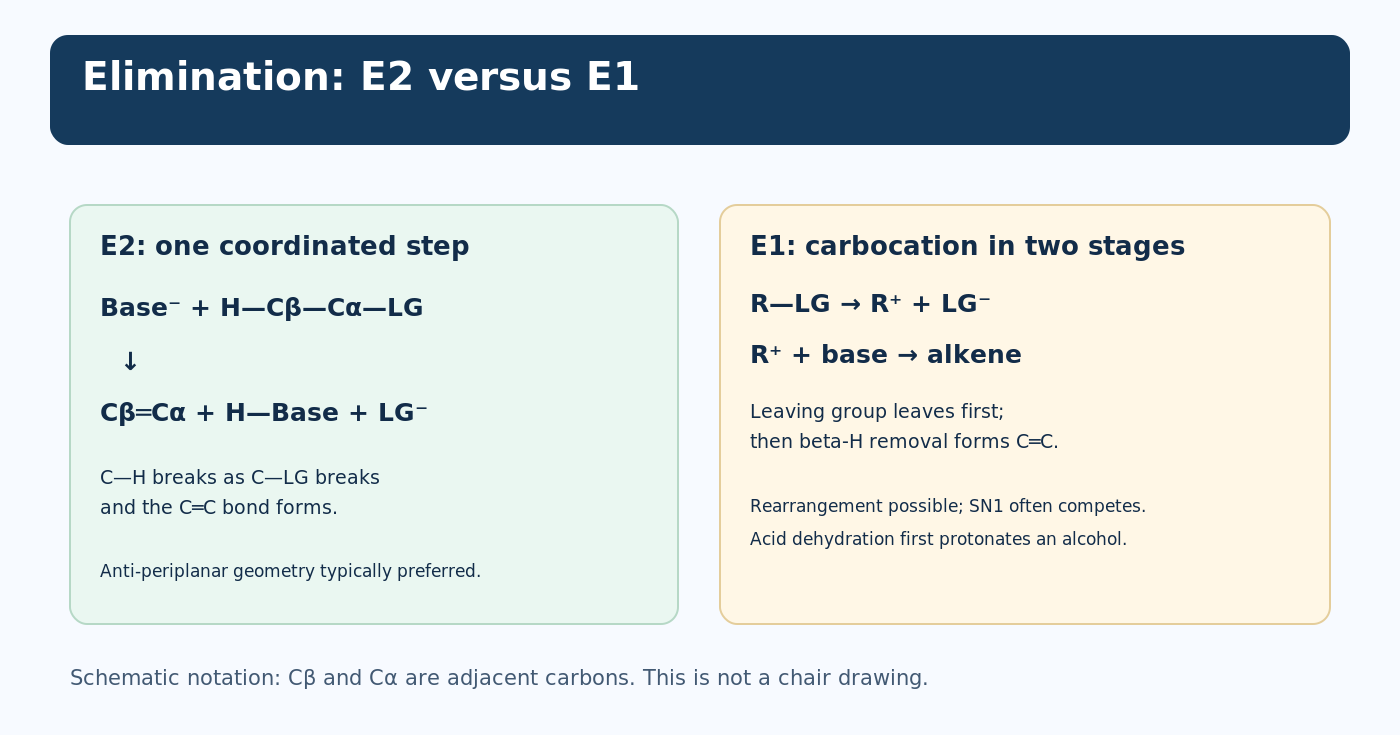
Review E2 versus E1
Worked conceptual example
A substituted bromocyclohexane with an equatorial leaving group
- Inspect the starting chair: equatorial Br is not positioned for the standard trans-diaxial E2.
- Ring-flip the molecule: Br becomes axial while keeping its up/down orientation.
- At adjacent carbons, search for axial hydrogens anti to Br.
- Draw alkene product(s) only at positions meeting the geometric requirement.
Answer: Elimination occurs only from a conformationally accessible trans-diaxial arrangement; the exact product depends on the actual substitution pattern.
Because product identity depends on the drawn stereochemistry and substituent locations, a general text example cannot replace a correctly drawn chair. Use a structure-verified diagram in any graded worksheet.
Common mistakes
- Ignoring whether the leaving group is equatorial or axial.
- Flipping a chair but mistakenly changing up into down.
- Choosing a β-carbon with no suitable axial H.
- Treating E2 as a carbocation reaction.
Quick self-check
Can an equatorial leaving group react directly by the usual trans-diaxial E2 route?
Not in that chair conformation. A suitable axial conformer must be accessible, along with an anti axial β-H.