
Nucleophilic Addition to Carbonyls
Track nucleophile attack, the tetrahedral intermediate, and protonation or workup.
1. Understand the Concept
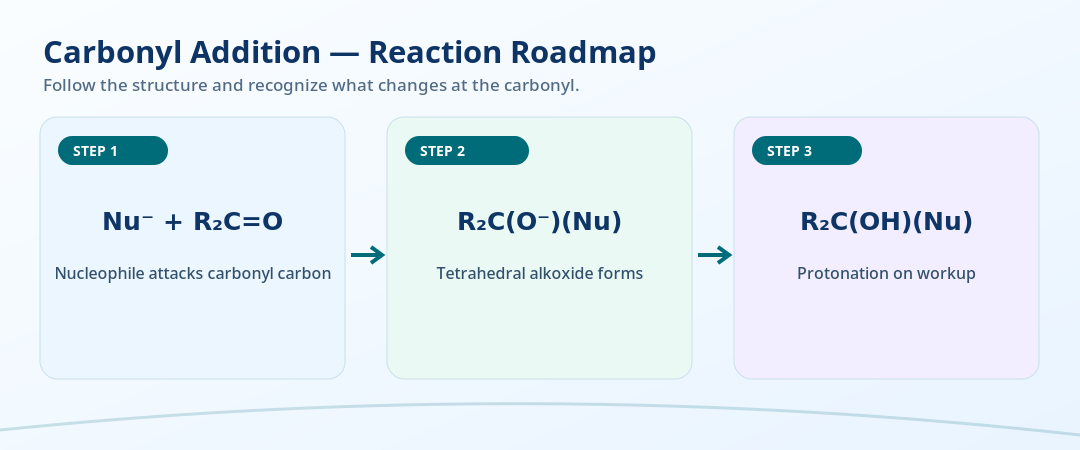
A nucleophile attacks the electrophilic carbon of an aldehyde or ketone, while the C=O π electrons move onto oxygen. The resulting tetrahedral intermediate is often protonated during workup. Under simple addition conditions the carbonyl carbon changes from sp² to sp³.
Learning outcome: Use reagents and conditions to predict additions of hydride and carbon nucleophiles to aldehydes and ketones.
2. Follow a Consistent Strategy
- Identify the substrate class: aldehyde or ketone.
- Identify the nucleophile and whether the reaction needs aqueous acidic workup.
- Form the new bond at the carbonyl carbon and move π electrons to oxygen.
- Protonate the alkoxide during workup; count carbon substituents to classify the alcohol.
3. See the Chemistry
4. Work Through Examples
Reduction with sodium borohydride
CH₃CHO →[NaBH₄; aqueous workup] CH₃CH₂OH
Hydride addition followed by protonation converts ethanal into a primary alcohol.
Addition of a Grignard reagent
CH₃CHO + CH₃MgBr →[ether; then H₃O⁺] CH₃CH(OH)CH₃
A new C–C bond forms; after workup ethanal becomes a secondary alcohol.
5. Avoid These Mistakes
- Drawing loss of an oxygen leaving group for a simple aldehyde/ketone addition.
- Forgetting protonation of the initial alkoxide in the product.
- Using a Grignard reagent in a protic solvent: water or alcohol quenches the organometallic reagent.
6. Review & Check Understanding
What happens to the C=O π bond during nucleophilic attack?
The π electron pair shifts onto oxygen as the nucleophile bonds to carbon.
What alcohol class forms when a ketone is reduced with NaBH₄?
A secondary alcohol.
7. Test Your Understanding
Try eight curated questions with explanations of every answer. You can repeat the set without creating an account.
Check your understanding
Eight carefully reviewed problems with feedback for each choice. Your answers stay in your browser.
Loading questions…