
Organic Chemistry Foundations Review
Review electron flow, acidity, resonance, valence, and reaction reasoning.
1. Understand the Concept
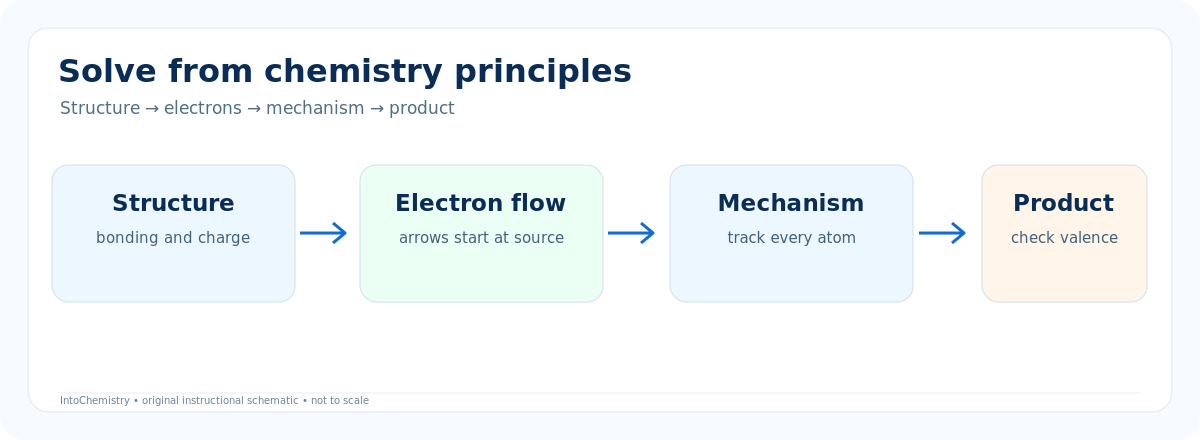
Accurate structures and electron bookkeeping are the foundation of mechanism prediction. Arrow tails start at electrons, valence must be preserved, and charges should balance across a transformation.
Your goal: Review electron flow, acidity, resonance, valence, and reaction reasoning.
2. Step-by-Step Exam Strategy
Ensure the correct atom, formal charge, and molecular formula before proposing a product.
Start at a lone pair or bond; end at an atom or bond location that receives the electrons.
Lower pKa means stronger acid; compare the acid on each side of a proton-transfer equilibrium.
Use resonance, inductive effects and steric access to justify mechanism preferences.
3. Visual Reference
4. Worked Example
Degree of unsaturation for C₆H₆
Ignoring oxygen and sulfur in the standard neutral formula, DBE = (2C + 2 − H)/2 = (12 + 2 − 6)/2 = 4. Benzene contains one ring and three π bonds.
5. Common Mistakes
- Drawing a curved arrow from a positive charge rather than an electron source.
- Assuming low pKa means a weak acid.
- Ignoring the carbon valence limit when drawing intermediates.
6. Practice & Reinforcement
Try the interactive questions below. In Practice mode, each answer includes an explanation. In Mock Exam mode, explanations appear after submitting the full set.
Interactive questions load when JavaScript is available. Download the printable study sets for offline review.