
Alcohol Oxidation & Carbonyl Reduction
Control the oxidation state without moving the carbonyl.
Learning objective
Choose reagents for alcohol-to-carbonyl and carbonyl-to-alcohol reactions.
1Classify the alcohol
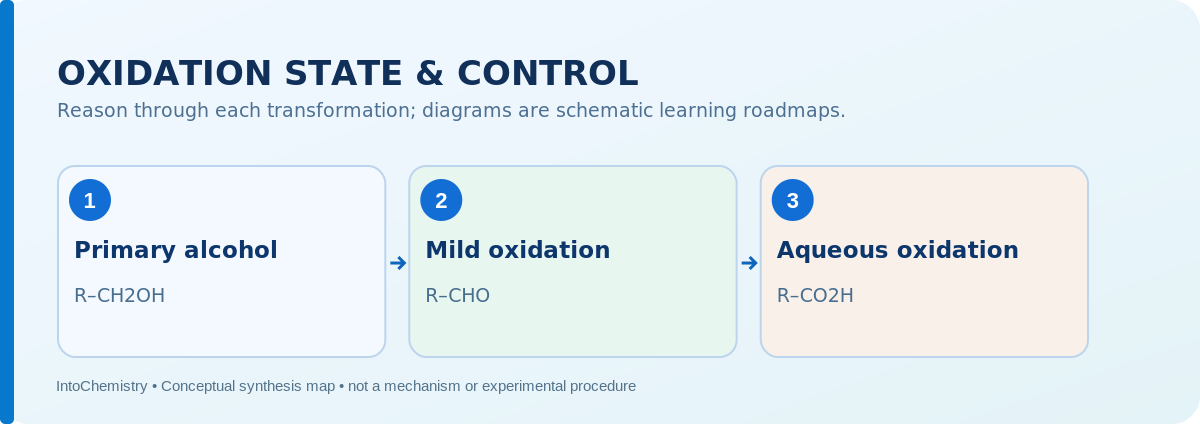
A primary alcohol can form an aldehyde or acid; a secondary alcohol can form a ketone; ordinary oxidation of a tertiary alcohol is not analogous because it lacks a hydrogen on the OH-bearing carbon.
2Stop at an aldehyde
PCC in anhydrous solvent is a commonly taught oxidation from a primary alcohol to an aldehyde.
3Oxidize to an acid
A strong aqueous Cr(VI) oxidation may convert primary alcohols to carboxylic acids. Avoid presenting all chromium conditions as interchangeable.
4Reduce with hydride
NaBH4 reduces common aldehydes and ketones to alcohols. Add a separate aqueous workup step for protonation.
5Worked example: 1-butene to 2-butanone
First form 2-butanol by Markovnikov hydration, then oxidize that secondary alcohol to 2-butanone. Hydroboration instead would give the wrong alcohol position.
Check your understanding
Why does PCC oxidation of 2-propanol give acetone?
Reveal explanation
The OH-bearing carbon is secondary, so oxidation forms a ketone at the same carbon.