
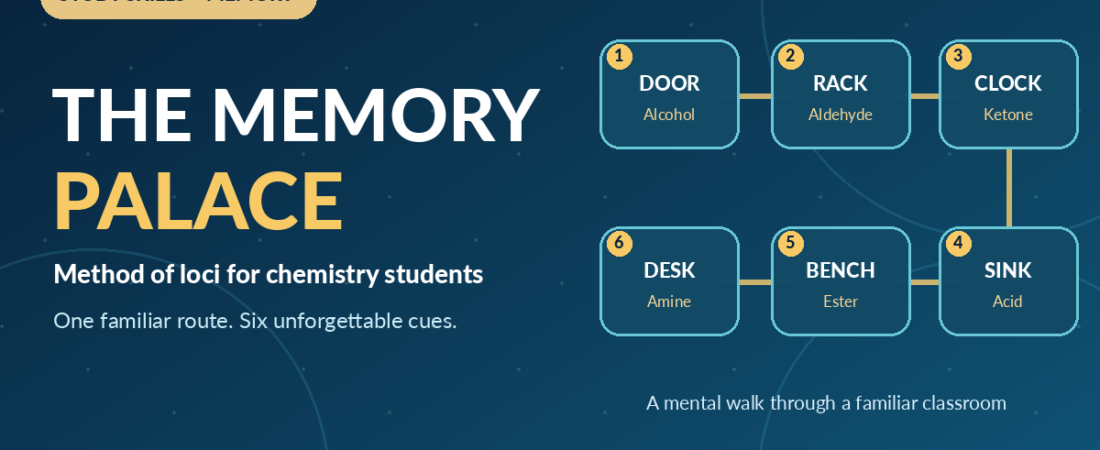
A memory palace is a journey through familiar places
Imagine walking a fixed route through your classroom. A vivid scene at each stop cues a chemistry concept; then practice recalling and drawing the actual structures without notes.
Six stops · One consistent route · Six meaningful retrieval cues
Can a memory palace help you remember chemistry? The memory palace technique—also called the method of loci—connects new information to familiar locations. Instead of trying to memorize a sequence from a page, you imagine placing vivid cues along a route you know well and then mentally walk that route to retrieve them. Researchers have found that the technique can improve recall, especially for ordered information, although it is not a substitute for understanding or solving problems. [1]
Quick answer: To build a memory palace, choose a familiar place, select a fixed route with distinct stops, create an unusual image for each fact, and rehearse the route from memory. For chemistry, try it with functional groups, spectroscopy clues, vocabulary, or a multistep procedure. Then check your understanding with real problems.
This evidence-based IntoChemistry guide explains the research, gives a complete six-stop example for organic chemistry, and shows how to combine memory palaces with active recall and spaced practice.
Jump to: What it is · Research · How to build one · Chemistry example · Practice plan · FAQs
What is a memory palace (method of loci)?
A locus is a place; loci is its plural. In the method of loci, you assign memorable images to a series of locations—for example, the front door, a hallway, a kitchen table, and a desk. When you want to recall the information, you revisit the places in the same order in your imagination.
You do not need to own a palace or have a photographic memory. A childhood home, a walk across campus, a classroom, or even a familiar grocery store can provide the route. What matters is that the stopping points are distinctive and their order stays consistent. The technique creates extra retrieval cues by combining spatial context, imagery, and active association. The precise contribution of each mechanism remains an area of research. [1]
Do memory palaces actually work? What the science says
A 2025 systematic review found benefits, but also study-quality concerns
A 2025 systematic review and meta-analysis in the British Journal of Psychology reported a large pooled effect on immediate serial recall compared with rehearsal (standardized effect d = 0.88; 95% confidence interval 0.47–1.25). That does not mean an 88% increase in memory. The authors also found heterogeneity, possible publication bias, and substantial methodological limitations; their certainty ratings were low to very low. The findings support memory palaces for particular recall tasks, not a guarantee of better examination scores. [1]
A 2021 meta-analysis also reported a positive effect
Twomey and Kroneisen’s 2021 meta-analysis examined 13 randomized controlled trials, many conducted in university settings. It reported a moderate average benefit for the loci method (Hedges’ g = 0.65; 95% CI 0.45–0.85), while noting concerns about experimental bias. This is consistent with a useful learning tool, but the strength of evidence varies by task and study design. [2]
What about brain scans and memory training?
A 2021 Science Advances study investigated memory athletes and participants trained in the method of loci over six weeks. The researchers reported better durable recall and changes in neural activity and connectivity associated with mnemonic training. These findings are interesting, but they do not establish that creating memory palaces increases general intelligence or makes someone remember everything. [3]
Evidence in one sentence: Memory palaces are a promising tool for remembering organized facts and sequences. The evidence is not strong enough to claim that they automatically improve comprehension, transfer to unfamiliar problems, or replace effective study habits.
How to build a memory palace in six steps
- Choose a place you know well. Your home, classroom, or usual walk to class is enough. You should be able to picture it without effort.
- Pick six to ten distinct locations. Use obvious landmarks rather than two nearly identical corners of a room.
- Fix the route. Always move through the locations in the same order. A predictable path helps you retrieve an ordered sequence.
- Translate each idea into a visual cue. Make the cue exaggerated or surprising, but ensure it represents the correct fact.
- Attach one primary idea to each stop. Imagine the cue interacting with the location, not simply floating nearby.
- Recall and verify. Close your notes, mentally walk the route, explain each answer, and then check for omissions or errors.
Tip: Start with only six locations. A short palace used accurately is more useful than a complicated thirty-room palace that you cannot reliably navigate.
A memory palace for organic chemistry: six functional groups
Imagine entering a familiar chemistry classroom. At each stop, an exaggerated object reminds you of a structural feature. The images below are an original study example, not tested or validated molecular illustrations. Verify the structures in your course materials, and remember that these are generic functional-group patterns rather than complete molecules.
| Stop on the classroom route | Visual memory cue | Chemistry fact to retrieve |
|---|---|---|
| 1. Door | A huge glowing OH sign hangs from a carbon-shaped door handle. | Alcohol: R–OH (hydroxyl group attached to carbon). |
| 2. Coat rack | An oversized C=O holds a tiny H at one end. | Aldehyde: R–C(=O)H (terminal carbonyl). |
| 3. Clock | Two carbon chains hold a giant C=O between them. | Ketone: R–C(=O)–R′ (carbonyl attached to two carbons). |
| 4. Sink | A carbonyl and an OH bubble stick to the same carbon. | Carboxylic acid: R–C(=O)OH. |
| 5. Lab bench | A carbonyl connects through an O bridge to another carbon group. | Ester: R–C(=O)–O–R′. |
| 6. Instructor desk | A giant nitrogen sits behind the desk, holding several carbon/hydrogen bonds. | Amine: primary R–NH₂, secondary R₂NH, or tertiary R₃N. |
The purpose is not to memorize the appearance of the giant objects. It is to use them as cues that trigger accurate structural drawings. A student who remembers “ketone” but cannot draw R–C(=O)–R′ still needs practice.
To test whether the associations transfer to chemistry questions, visit the functional groups and IUPAC naming lesson. Look at unfamiliar structures, identify their functional groups, and explain your choices without using the palace.
Can a memory palace help with stoichiometry?
Yes—as a way to remember a problem-solving checklist, not as a replacement for dimensional analysis. A possible classroom route is: door = balance the chemical equation; balance = convert a supplied mass to moles; fume hood = use the balanced mole ratio; sink = convert moles into the requested units; desk = check units and whether a limiting reagent must be considered.
A memory cue can remind you what to check next. Only solving actual problems will teach you whether the ratios, units, and chemical assumptions are correct. Try the step-by-step stoichiometry practice lesson afterward.
When is a memory palace useful—and when is it not?
| Good candidate for a memory palace | Practice still needed |
|---|---|
| Named functional groups and key structures | Identifying groups in unfamiliar or complex molecules |
| Ordered laboratory or calculation checklists | Handling exceptions, safety decisions, and unexpected results |
| Qualitative IR or NMR reference cues | Interpreting actual spectra and overlapping evidence |
| Vocabulary, reaction conditions, classifications | Predicting mechanisms, stereochemical outcomes, and competing reactions |
| A defined sequence of ideas for oral review | Explaining relationships and applying principles to new cases |
Combine memory palaces with active recall and spaced practice
For durable course learning, do not make your memory palace the entire study session. A major 2013 review of learning techniques found broader support for practice testing and distributed practice across learning contexts than for many popular passive study habits. That review did not establish a single ideal memory-palace schedule, so the plan below is an illustrative IntoChemistry routine, not a proven optimum. [4]
- First session (about 10 minutes): Read the six functional-group definitions, build the images, and immediately test yourself with notes hidden.
- Later that day: Walk the route without looking and draw every functional group from memory. Correct any errors.
- Next day: Retrieve the route again, then identify functional groups in six new molecules.
- Several days later: Try a short closed-book quiz and a problem set. Spend more time on the groups you miss.
- The following week: Repeat the retrieval test and use the terms in authentic chemistry questions.
If you want a more complete weekly approach, see how many hours to study chemistry and the guided chemistry study paths. You can also use free chemistry worksheets to practice without memorization cues.
Five common memory-palace mistakes
- Choosing locations that look alike: similar stops can blur together; use landmarks with distinct visual identities.
- Overloading each stop: put one primary fact at a location before adding fine details.
- Remembering the joke instead of the chemistry: after recall, always write the correct symbol, formula, or reasoning.
- Using the route instead of solving problems: being able to name the step is not the same as completing it accurately.
- Never revisiting the palace: recall can fade; practice retrieving and checking the information over time.
Frequently asked questions about memory palaces
How long does it take to make a memory palace?
A simple route of six familiar stops can be created in a short study session, though some learners need more setup time. Start small and expand only if the basic route is reliable.
Can a memory palace help on a chemistry exam?
It can help you retrieve memorized information, especially sequences and structural reminders. Success on exams that require calculations or unfamiliar reaction predictions also depends on conceptual understanding and problem-solving practice.
Do I need to be good at visualizing pictures?
Not necessarily. Distinct spatial landmarks, verbal stories, movement, and unusual associations may all help. If vivid imagery is difficult, use a clearly ordered route and meaningful labels; evaluate whether the technique works for you instead of forcing it.
Is a memory palace better than flashcards?
The two methods serve different purposes. A memory palace organizes cues along a fixed route; flashcards can support flexible retrieval practice and review over time. Try both, and judge success by later closed-book recall and problem performance, not by how easy studying feels.
Does the science prove memory palaces improve intelligence?
No. Research supports better performance on certain memory tasks and has explored associated brain changes, but that is not evidence of higher general intelligence or guaranteed long-term academic improvement. [1] [3]
The bottom line
A memory palace is a practical way to make important facts easier to retrieve. For chemistry, use it to anchor definitions, structures, and ordered checklists. Then deliberately practice the next step: draw structures, explain mechanisms, solve problems, and test yourself without cues. The strongest study strategy is not an elaborate mnemonic alone; it is an accurate memory cue connected to meaningful retrieval and application.
Research references and further reading
- Ondřej, J. (2025). The method of loci in the context of psychological research: A systematic review and meta-analysis. British Journal of Psychology, 116(4), 930–986. https://doi.org/10.1111/bjop.12799
- Twomey, C., & Kroneisen, M. (2021). The effectiveness of the loci method as a mnemonic device: Meta-analysis. Quarterly Journal of Experimental Psychology, 74(8), 1317–1326. https://doi.org/10.1177/1747021821993457
- Wagner, I. C., et al. (2021). Durable memories and efficient neural coding through mnemonic training using the method of loci. Science Advances, 7(10), eabc7606. https://doi.org/10.1126/sciadv.abc7606
- Dunlosky, J., et al. (2013). Improving students’ learning with effective learning techniques: Promising directions from cognitive and educational psychology. Psychological Science in the Public Interest, 14(1), 4–58. https://doi.org/10.1177/1529100612453266
Editorial note: The classroom memory-palace scenarios and practice schedule are original teaching examples, not interventions tested in the studies cited. The research concerns performance on memory tasks; it does not establish a guaranteed improvement in chemistry course grades.