
Alcohol Reactions: Oxidation, Dehydration & Substitution
Use alcohol structure and reaction conditions to predict carbonyls, alkenes, and substitution products.
1. Understand the concept
An alcohol has an –OH group attached to carbon. The outcome depends on whether the alcohol is primary, secondary, or tertiary and which reagents are present.
Learning goal: Use alcohol structure and reaction conditions to predict carbonyls, alkenes, and substitution products.
2. Use a reliable prediction strategy
- Classify the carbon bonded to OH as primary, secondary, or tertiary.
- Identify the reagent family: oxidation, dehydration, or activation/substitution.
- Identify possible rearrangements under strongly acidic conditions.
- Draw the major product and confirm atom connectivity and functional group.
3. Follow the reaction roadmap
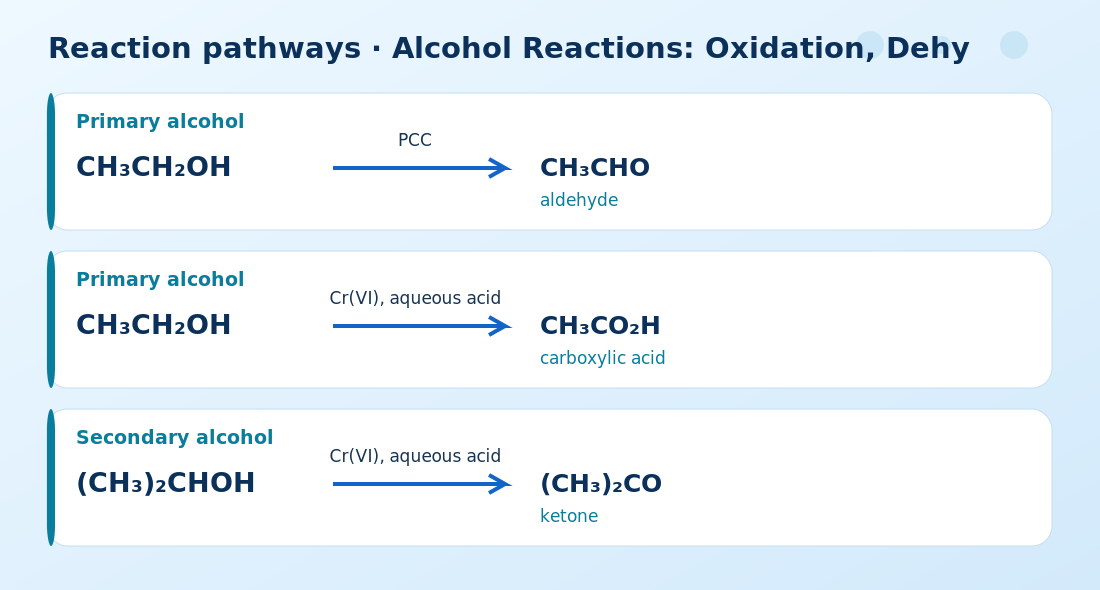
4. Work through examples
Primary alcohol + PCC
CH₃CH₂OH + PCC → CH₃CHO
Under anhydrous conditions PCC commonly oxidizes a primary alcohol to an aldehyde. Use correct product class before naming.
Secondary alcohol + oxidant
CH₃CH(OH)CH₃ + Na₂Cr₂O₇/H₂SO₄ → CH₃COCH₃
A secondary alcohol oxidizes to a ketone. Oxidation normally stops there because no hydrogen remains on the carbinol carbon.
5. Common mistakes
- Assuming every oxidant stops a primary alcohol at the aldehyde; aqueous chromium(VI) conditions generally allow further oxidation to acid.
- Claiming simple tertiary alcohols undergo ordinary oxidation to ketones; cleavage would be needed under harsh conditions.
- Predicting only one alkene for unsymmetrical acid-catalyzed dehydrations without checking rearrangement and regioselectivity.
6. Check understanding
Compare the oxidation of 1-propanol under PCC and aqueous Jones conditions.
PCC commonly produces propanal; Jones oxidation generally yields propanoic acid.
Why is 2-methyl-2-propanol resistant to ordinary oxidation?
The carbon bearing OH has no C–H bond; normal oxidation to a carbonyl would require C–C bond cleavage.
7. Practice the reactions
Use the quiz below to apply the rules to new substrates and reagents. A correct answer is explained, not merely marked.
Try the reaction challenge
Answer eight curated questions. Review the explanation after each answer.
Loading quiz…