
Alkene Addition Reactions: Predict the Product
Compare hydrohalogenation, hydration, bromination and hydroboration with predictable regiochemistry.
Understand the concept
Alkenes undergo addition reactions because the π bond can be converted into new σ bonds. Product prediction requires more than remembering a product: you must identify the reagent, mechanism, regioselectivity and stereochemical outcome.
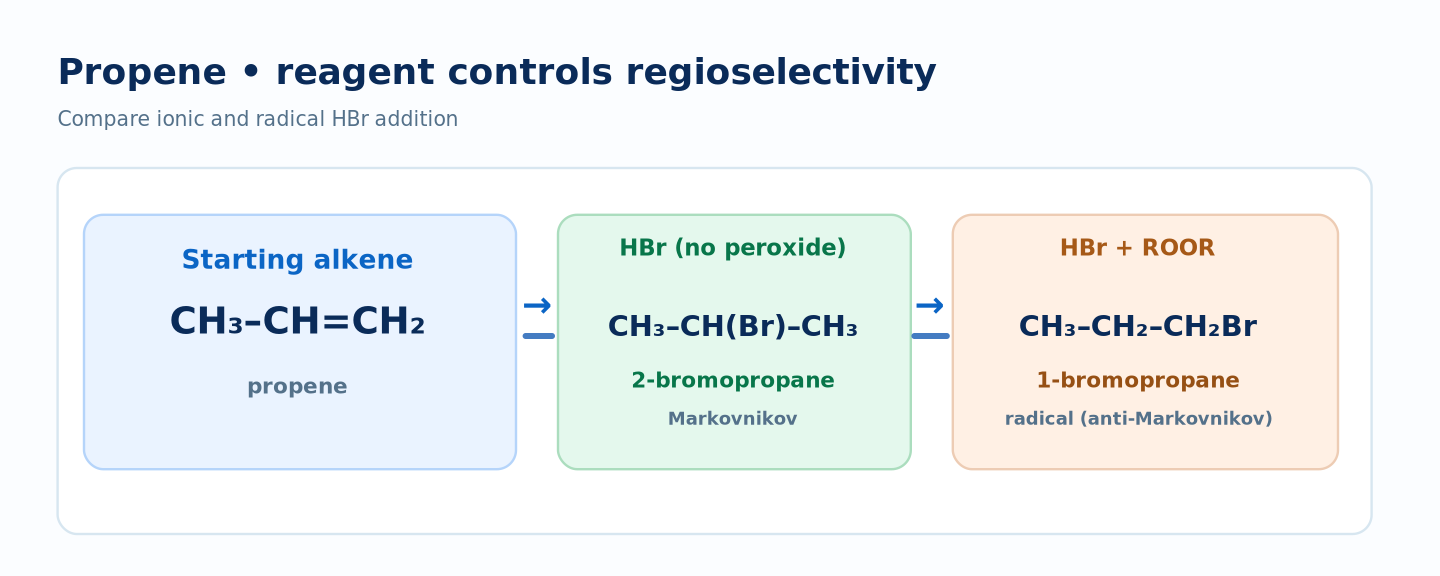
For propene, HBr without peroxides normally follows electrophilic hydrohalogenation and gives mainly 2-bromopropane. With suitable radical initiators/peroxides, HBr addition can favor 1-bromopropane. The peroxide effect is not generally transferable to HCl or HI.
A reliable four-step approach
- Identify whether the reagent adds H/X, H/OH, X/X or H/H across the C=C.
- Determine whether the pathway uses carbocation, radical, concerted or cyclic halonium chemistry.
- Apply regioselectivity only to the appropriate mechanism.
- Check stereochemistry, possible rearrangement and any competing products.
Visual explanation
Work through the examples
Propene + HBr, no peroxides
Protonation generates the more stable secondary carbocation rather than a primary carbocation. Bromide attacks the carbocation.
Result: Major product: 2-bromopropane (Markovnikov addition).
Propene + BH₃·THF, then H₂O₂/NaOH
Hydroboration adds B to the less substituted carbon and H to the other carbon in a concerted syn addition. Oxidation replaces B with OH with retention at that carbon.
Result: Product: propan-1-ol (anti-Markovnikov alcohol).
Common mistakes
- Applying the HBr peroxide effect automatically to HCl or HI.
- Calling hydroboration an anti addition: it is syn addition.
- Assuming all acid-catalyzed hydration reactions avoid carbocation rearrangements.
Check your understanding
What is the major product of propene + HBr without peroxides?
Normal ionic addition of HBr to propene gives mostly 2-bromopropane.
Complete the interactive practice below to check more questions and review explanations.
Interactive Practice
Answer curated questions, then review the scientific explanation.
Loading practice questions…