
Assigning R and S Configuration: A Visual Guide
Practice CIP priorities, viewpoint and the clockwise/counterclockwise rule for stereocenters.
Understand the concept
The Cahn–Ingold–Prelog (CIP) rules assign priorities to four groups around a stereocenter. Higher atomic number wins at the first atom; when first atoms tie, compare atoms at the next layer in descending atomic number order.
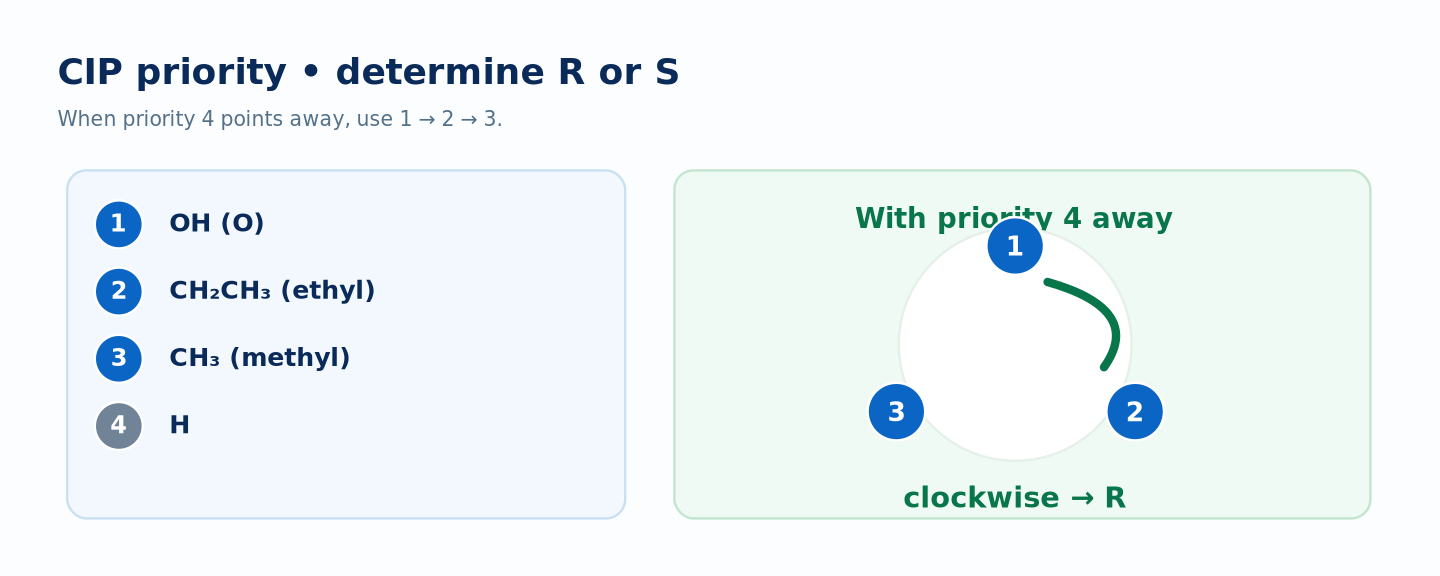
With the lowest-priority group pointing away, clockwise movement from priority 1 → 2 → 3 indicates R, and counterclockwise indicates S. When priority 4 faces the viewer, reverse the apparent result.
A reliable four-step approach
- Identify a tetrahedral atom attached to four different substituents.
- Rank substituents using the first point of difference and atomic number.
- Reorient mentally so priority 4 points away; a dashed bond helps.
- Trace 1 → 2 → 3: clockwise gives R; counterclockwise gives S when 4 is away.
Visual explanation
Work through the examples
Rank OH, CH₂CH₃, CH₃ and H around the stereocenter of butan-2-ol.
Compare atoms directly attached: O beats C beats H. Both carbon groups begin with C; their next atom lists are (C,H,H) for ethyl and (H,H,H) for methyl.
Result: OH = 1; ethyl = 2; methyl = 3; H = 4.
The priority-4 group points away and 1 → 2 → 3 is counterclockwise.
The lowest-priority substituent is already oriented correctly, so apply the visible order directly.
Result: Configuration is S.
Common mistakes
- Ranking groups by total molecular size instead of first-point-of-difference atomic number.
- Forgetting to invert the apparent direction when priority 4 points toward you.
- Assuming R always corresponds to positive optical rotation.
Check your understanding
With priority 4 pointing away, a clockwise 1 → 2 → 3 sequence is:
Clockwise with the lowest priority away is R.
Complete the interactive practice below to check more questions and review explanations.
Interactive Practice
Answer curated questions, then review the scientific explanation.
Loading practice questions…