
Epoxide Ring Opening: Acidic vs Basic Conditions
Predict which epoxide carbon is attacked and where the new C–Nu bond forms.
1. Understand the concept
Epoxides are strained, three-membered cyclic ethers. Ring opening relieves ring strain and forms a new C–Nu bond while breaking one C–O bond.
Learning goal: Predict which epoxide carbon is attacked and where the new C–Nu bond forms.
2. Use a reliable prediction strategy
- Identify whether the conditions are basic/strong-nucleophile or acid-catalyzed.
- Under ordinary basic conditions favor attack at the less substituted epoxide carbon by SN2-like attack.
- Under acid catalysis, inspect both epoxide carbons: when one carbon is tertiary, more-substituted attack is often favored; if both are primary or secondary, less-substituted attack can dominate.
- Account for backside attack at the reacting carbon and proton transfer after ring opening.
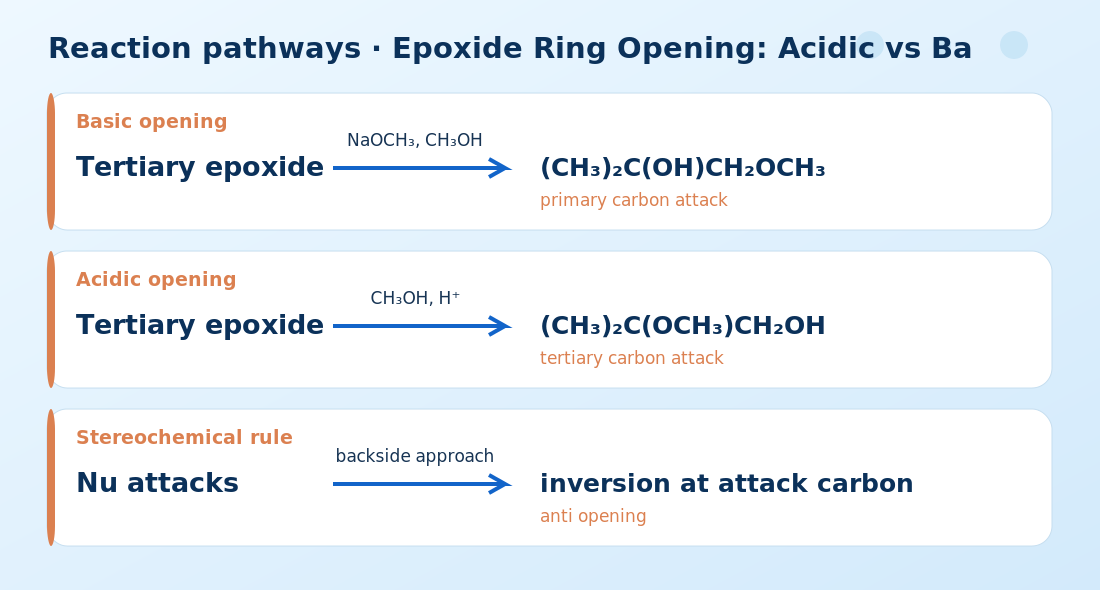
3. Follow the reaction roadmap
4. Work through examples
Methoxide under basic conditions
Propylene oxide + NaOCH₃/CH₃OH → CH₃CH(OH)CH₂OCH₃
Methoxide preferentially attacks the less substituted terminal carbon; after protonation the original O becomes OH.
Methanol under acid catalysis
2-Methyl-1,2-epoxypropane + CH₃OH/H⁺ → (CH₃)₂C(OCH₃)CH₂OH
With a tertiary epoxide carbon, acid activation can favor attack there; other epoxides may behave differently.
5. Common mistakes
- Assuming acid-catalyzed ring opening is an ordinary free-carbocation SN1 process.
- Forgetting that the epoxide oxygen remains in the product as an alcohol after workup.
- Reversing the carbon that receives the external nucleophile.
6. Check understanding
Compare basic and acid-catalyzed methanol opening of 2-methyl-1,2-epoxypropane.
Basic methoxide attacks the primary CH₂ carbon, leading to (CH₃)₂C(OH)CH₂OCH₃. Under acidic conditions methanol can favor the tertiary carbon, leading to (CH₃)₂C(OCH₃)CH₂OH.
Does protonated epoxide opening always involve a freely rearranging carbocation?
No. Protonated epoxides are activated, but the C–O bond cleavage and nucleophile attack can remain concerted or asynchronous; ordinary carbocation rearrangements are not expected as a general rule.
7. Practice the reactions
Use the quiz below to apply the rules to new substrates and reagents. A correct answer is explained, not merely marked.
Try the reaction challenge
Answer eight curated questions. Review the explanation after each answer.
Loading quiz…