
IntoChemistry · General Chemistry
Limiting Reactant Problems: Step-by-Step
Identify which reagent runs out first and calculate theoretical product amount.
◎ Clear explanations◉ Worked examples▤ Practice problems⬇ Free resources
What is the limiting reactant?
The limiting reactant is the substance consumed first when a reaction proceeds according to its balanced equation. The amount available determines the maximum theoretical amount of product. Other reactants remain in excess.
The reliable four-step method
- Balance the reaction before doing any amount calculations.
- Convert mass or particles to moles as necessary.
- Compute available moles / coefficient for every reactant, then select the smallest positive value.
- Multiply that smallest value by the product coefficient. Convert product moles to grams if asked.
See the reaction-extent comparison
Worked problems
Example 1
Water from hydrogen and oxygen
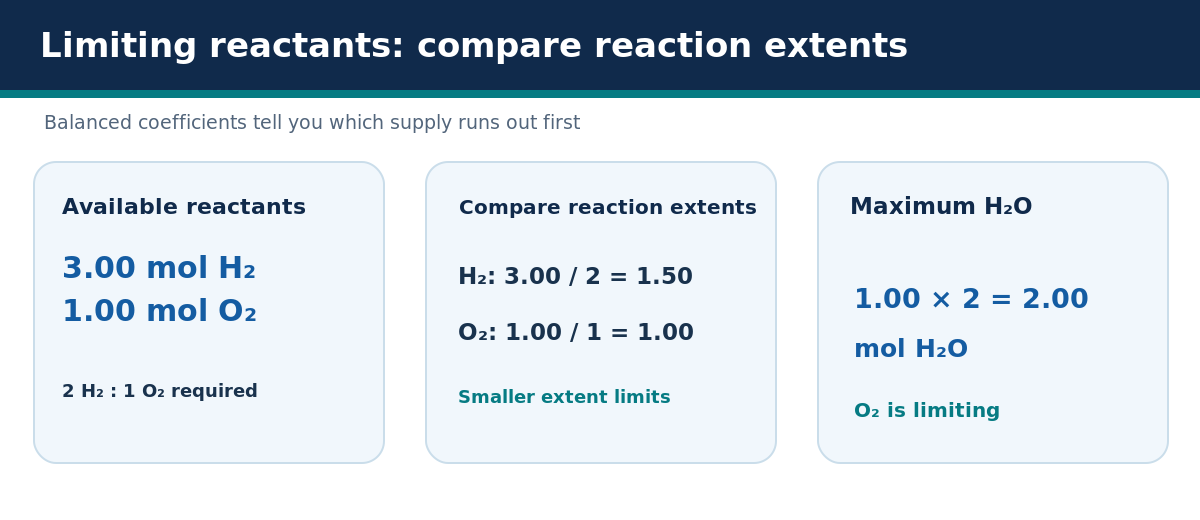
- Balanced: 2 H₂ + O₂ → 2 H₂O.
- Available: 3.00 mol H₂ and 1.00 mol O₂.
- Extents: 3.00 / 2 = 1.50 for H₂; 1.00 / 1 = 1.00 for O₂.
- O₂ is limiting; H₂O = 1.00 × 2 = 2.00 mol.
- H₂ consumed = 2.00 mol; 1.00 mol H₂ remains.
O₂ limits the reaction; 2.00 mol water theoretically forms.
Example 2
Ammonia production
- N₂ + 3 H₂ → 2 NH₃.
- Available: 1.50 mol N₂ and 3.00 mol H₂.
- Extents: 1.50 / 1 = 1.50; 3.00 / 3 = 1.00.
- H₂ is limiting. Maximum NH₃ = 1.00 × 2 = 2.00 mol.
- Using 17.03 g/mol for NH₃, theoretical mass is 34.1 g.
H₂ limits the reaction; 2.00 mol or approximately 34.1 g NH₃.
Common misconceptions
- The reactant with fewer moles is not necessarily limiting.
- The theoretical yield is a model maximum; an actual yield may be smaller.
- The reactants must be expressed in comparable mole units before using ratios.
- When reaction extents are equal, neither reactant is in excess under the ideal stoichiometric model.
Quick check
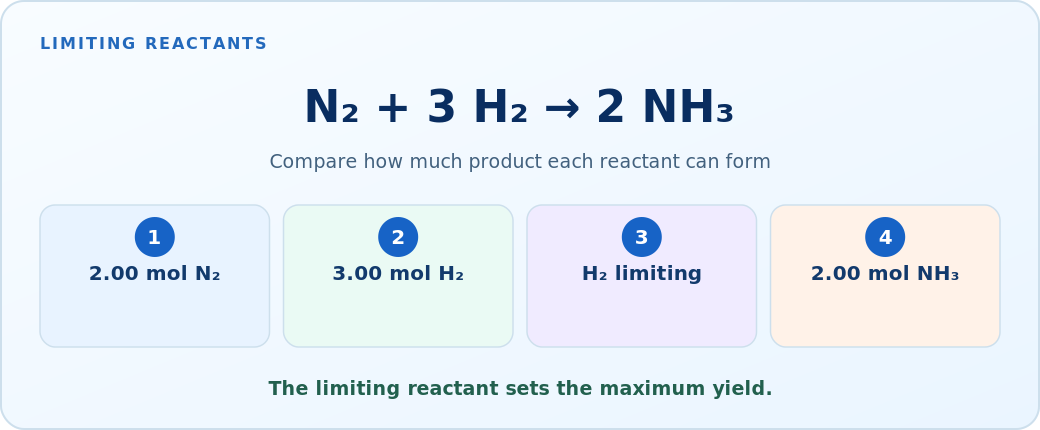
For N₂ + 3 H₂ → 2 NH₃, which reactant limits when you have 2.00 mol N₂ and 3.00 mol H₂?
H₂: ratios are 2.00/1 = 2.00 for N₂ versus 3.00/3 = 1.00 for H₂. Maximum NH₃ is 2.00 mol.
Interactive Limiting Reactant Problems: Step-by-Step Practice
Apply what you have learned using immediate feedback.
Limiting reactant calculator practice
Practice with a curated chemistry question bank. Check your result, read the explanation, then try another.