
IntoChemistry · General Chemistry
Molarity: Formula, Examples & Calculator
Understand concentration, solve molarity problems step by step, and check your calculations with a free tool.
◎ Clear explanations◉ Worked examples▤ Practice problems⬇ Free resources
What is molarity?
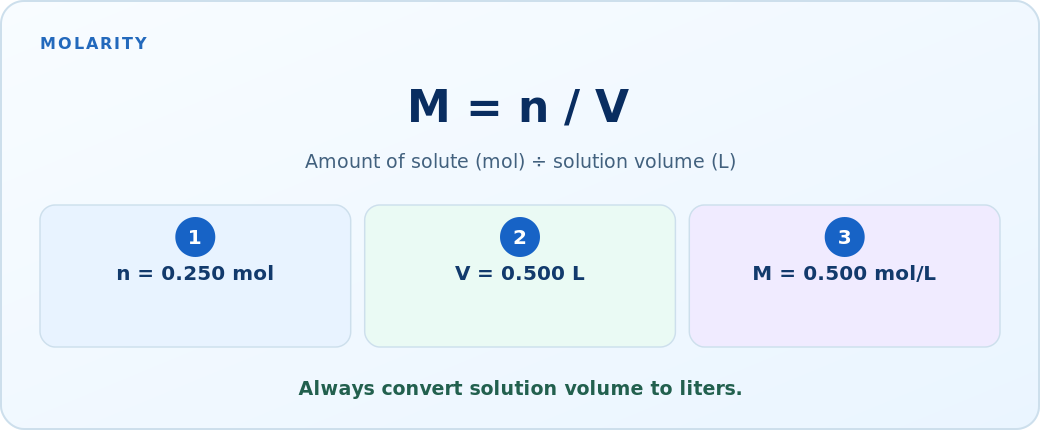
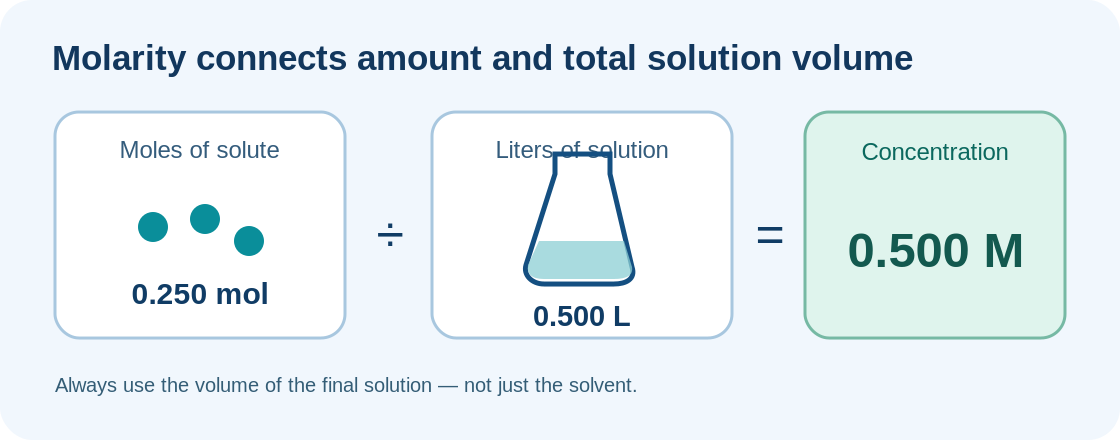
Molarity measures the concentration of a dissolved solute in terms of the amount of solute per liter of final solution.
M = mol soluteL solution
How to solve a molarity problem
- Identify the solute and the final solution volume.
- Convert milliliters to liters (divide mL by 1000).
- If given grams, divide by the solute molar mass to find moles.
- Divide moles by liters. Label the result mol/L or M.
- Round based on measured-data precision.
Visualize the formula
Worked examples
Worked example
Find molarity from moles and liters
- Given: 0.250 mol NaCl dissolved to make 0.500 L of solution.
- Apply M = n/V = 0.250 mol ÷ 0.500 L.
- Keep three significant figures.
Answer: 0.500 M NaCl.
Worked example
Find molarity from 5.85 g NaCl in 500.0 mL of solution
- Molar mass NaCl = 22.99 + 35.45 = 58.44 g/mol.
- Moles NaCl = 5.85 g ÷ 58.44 g/mol = 0.1001 mol.
- Volume = 500.0 mL × (1 L / 1000 mL) = 0.5000 L.
- Molarity = 0.1001 mol ÷ 0.5000 L.
Answer: 0.200 M NaCl (three significant figures).
Common mistakes
- Using solvent volume instead of total solution volume.
- Dividing grams directly by liters and calling the result molarity.
- Forgetting to convert milliliters to liters.
- Treating a calculator result as though it has unlimited significant figures.
Quick self-check
What happens to molarity if the solution volume doubles while moles stay constant?
The molarity is halved because M = n/V.
Interactive Molarity: Formula, Examples & Calculator Practice
Apply what you have learned using immediate feedback.
Calculator
Molarity Calculator
Molarity (M) = moles of solute ÷ liters of solution. Enter solution volume, not solvent volume.
For significant figures, report the result to the lesser of the input measurement precisions.