
IntoChemistry · General Chemistry
How to Write Ionic Compound Formulas
Use ion charges and the lowest whole-number ratio to write neutral ionic compounds with confidence.
◎ Clear explanations◉ Worked examples▤ Practice problems⬇ Free resources
Ions combine to make electrically neutral compounds
An ionic compound contains positively charged cations and negatively charged anions. A correct ionic formula gives the simplest whole-number ratio of ions whose charges add to zero.
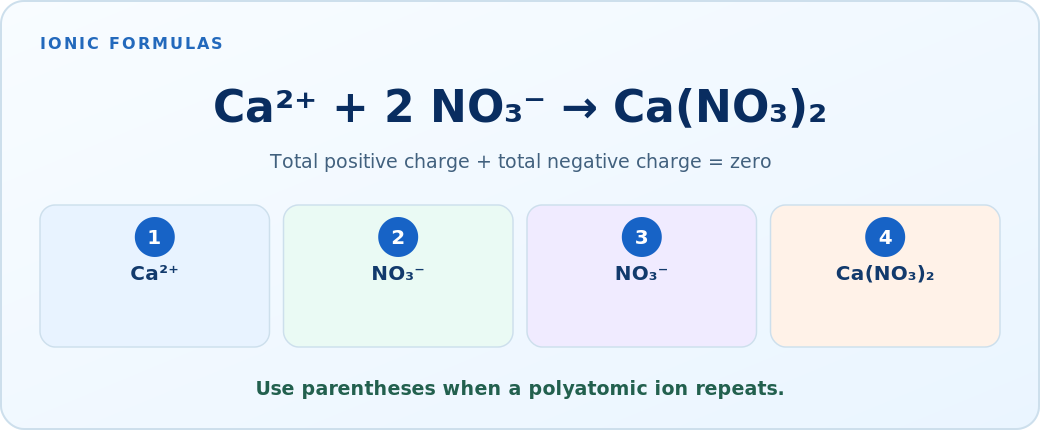
A reliable four-step method
- Identify the correct cation, anion, and their charges.
- Find the smallest total charge magnitude divisible by both charges (least common multiple).
- Determine how many of each ion are needed to reach equal positive and negative charges.
- Write the cation first, use lowest whole-number subscripts, and place parentheses around a polyatomic ion when you need more than one of it.
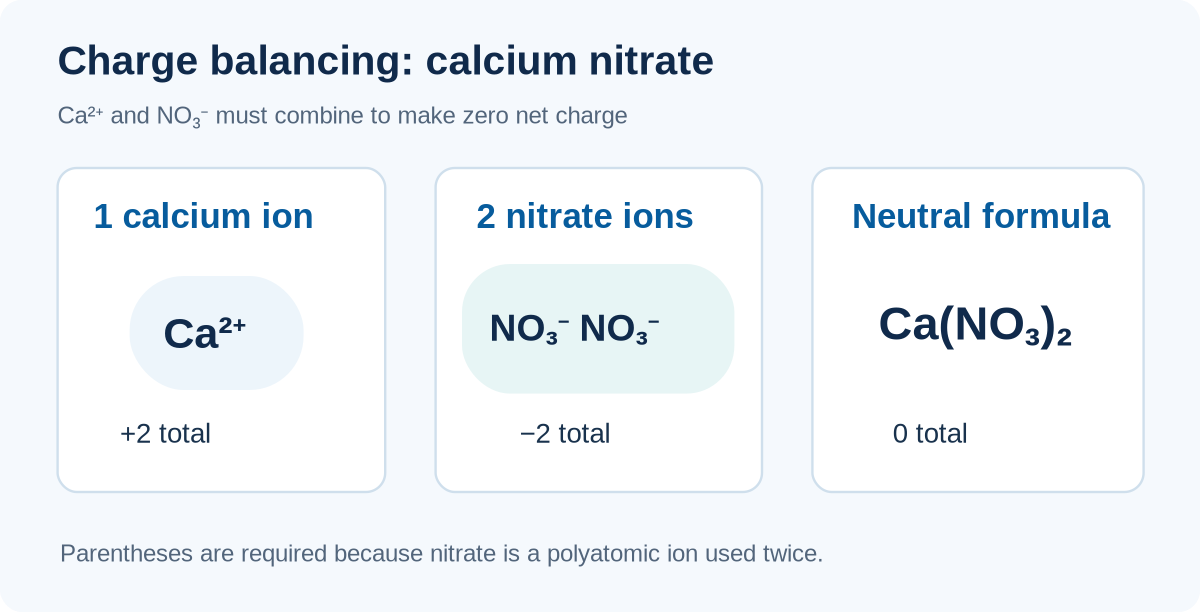
Why calcium nitrate needs parentheses
Three worked examples
Worked example 1
Aluminum oxide
- Aluminum forms Al³⁺; oxide is O²⁻.
- The lowest common multiple of 3 and 2 is 6.
- Use two Al³⁺ ions (+6) and three O²⁻ ions (−6).
Formula: Al₂O₃.
Worked example 2
Calcium nitrate
- Ca²⁺ and nitrate NO₃⁻ have charges +2 and −1.
- Use one Ca²⁺ and two nitrate ions.
- Nitrate stays intact: enclose it in parentheses before the 2.
Formula: Ca(NO₃)₂, not CaNO₆.
Worked example 3
Iron(III) oxide
- Roman numeral III specifies Fe³⁺, not Fe²⁺.
- Two Fe³⁺ ions balance three O²⁻ ions.
- Write the simplest ion ratio, not a molecular formula.
Formula: Fe₂O₃.
Common naming and formula errors
- Skipping charge balance: CaCl is not neutral; Ca²⁺ needs two Cl⁻, giving CaCl₂.
- Forgetting parentheses: Ca(NO₃)₂ has two complete nitrate ions.
- Using Roman numerals as subscripts: iron(III) means Fe³⁺, not Fe₃.
- Applying ionic rules to covalent compounds: CO₂ is molecular and must not be predicted using ion charge crisscrossing.
Check your understanding
Why is Mg₂O₂ not the standard formula for magnesium oxide?
It represents a reducible 2:2 ion ratio. The lowest whole-number ratio of Mg²⁺ to O²⁻ is 1:1, so the formula is MgO.
When are parentheses required?
When a polyatomic ion is repeated. One sulfate: Na₂SO₄ (no parentheses). Two nitrates: Ca(NO₃)₂ (parentheses).
Interactive How to Write Ionic Compound Formulas Practice
Apply what you have learned using immediate feedback.
Interactive chemistry practice
Write the ionic formula
Use the cation and anion charges to write a neutral, lowest-whole-number formula. Capitals matter.