
IntoChemistry · General Chemistry
Periodic Trends: Atomic Radius, Ionization Energy, and Electronegativity
Understand why properties change across rows and down columns of the periodic table.
◎ Clear explanations◉ Worked examples▤ Practice problems⬇ Free resources
Don’t memorize arrows without explanations
Periodic trends arise from interactions between nuclear charge, distance of the outer electrons from the nucleus, electron shielding, and electron arrangement. Simple direction arrows are a helpful first approximation, not absolute rules.
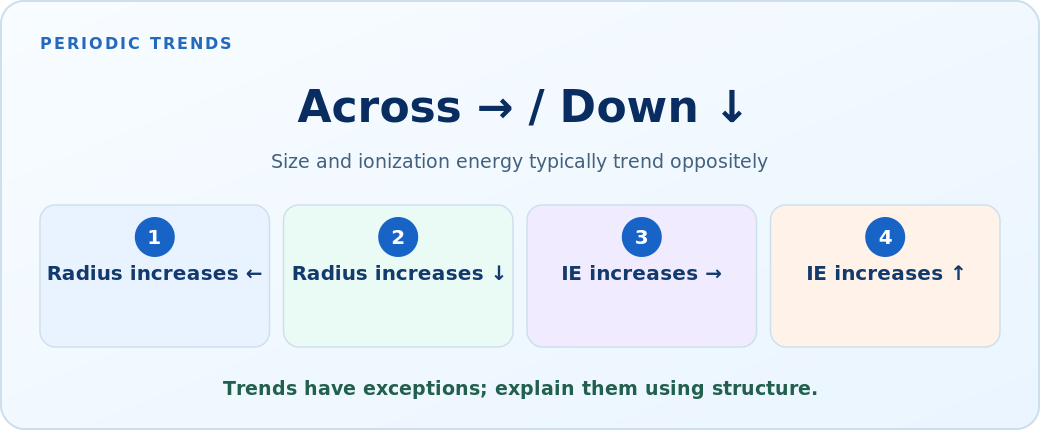
Visual trend map
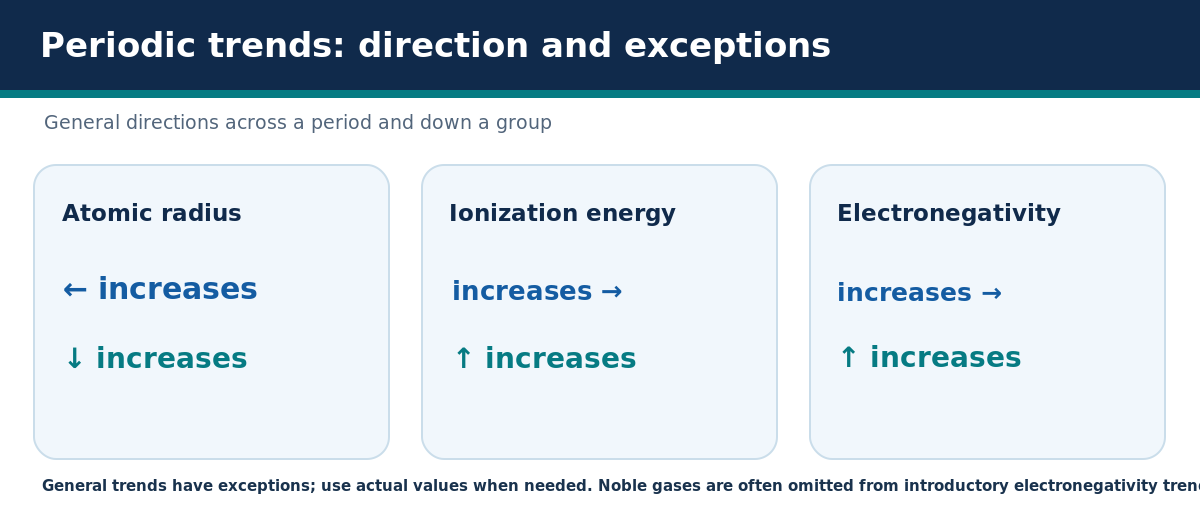
Three major properties
- Atomic radius: a measure of atomic size, defined in different ways. It usually decreases across a period and increases down a group.
- First ionization energy: energy to remove the first electron from a gas-phase atom. It generally increases across a period and decreases down a group.
- Electronegativity: relative tendency to attract shared electrons in a chemical bond. It generally rises toward fluorine; individual scales and bonding environments can affect the reported value.
Worked comparisons
Example 1
Na versus Cl: larger atom?
- Both are in period 3.
- Across the period the nuclear attraction felt by valence electrons generally becomes stronger.
- Na lies farther left and has the larger atomic radius.
Na is larger.
Example 2
Li versus K: higher first ionization energy?
- Both are group 1 elements.
- Potassium’s valence electron is farther from the nucleus and more shielded.
Li has the higher first ionization energy.
Example 3
Be versus B: identify an exception
- The general trend predicts increasing first ionization energy across period 2.
- However, the first electron removed from B occupies a 2p orbital whereas Be has filled 2s subshell character.
Be has a higher first ionization energy than B, an important exception.
Common exceptions
- For first ionization energy, B is lower than Be and O is lower than N.
- Electronegativity values are scale-dependent, and noble gases are often omitted from introductory charts.
- Cation and anion radii require more care than neutral-atom radius comparisons.
Quick check
Why is potassium larger than sodium?
K occupies another principal electron shell. Its outer electrons are farther from the nucleus on average.
Interactive Periodic Trends: Atomic Radius, Ionization Energy, and Electronegativity Practice
Apply what you have learned using immediate feedback.
Periodic trends challenge
Practice with a curated chemistry question bank. Check your result, read the explanation, then try another.