
SN1 vs SN2 vs E1 vs E2: Choose the Pathway
Predict substitution or elimination by analyzing the substrate, reagent, solvent and reaction temperature together.
Why mechanism prediction is a decision, not a memorized rule
More than one pathway can be possible. Begin with the carbon bearing the leaving group, then evaluate nucleophile or base strength, solvent and temperature. Predict the major pathway and consider likely competitors.
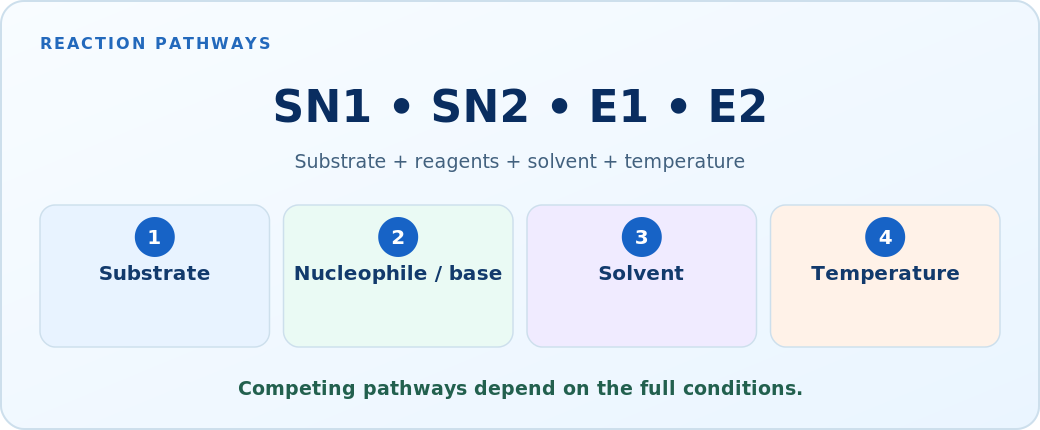
A four-question decision process
- Substrate: methyl, primary, secondary or tertiary? More substitution generally blocks SN2 and can favor carbocation pathways.
- Reagent: effective nucleophile, strong base, bulky base or weak nucleophile/base?
- Solvent: polar aprotic often improves anionic SN2 nucleophilicity; polar protic can support ionization when the substrate allows it.
- Temperature: higher temperature often increases elimination relative to substitution, but it is not a stand-alone mechanism test.
Reaction pathway overview
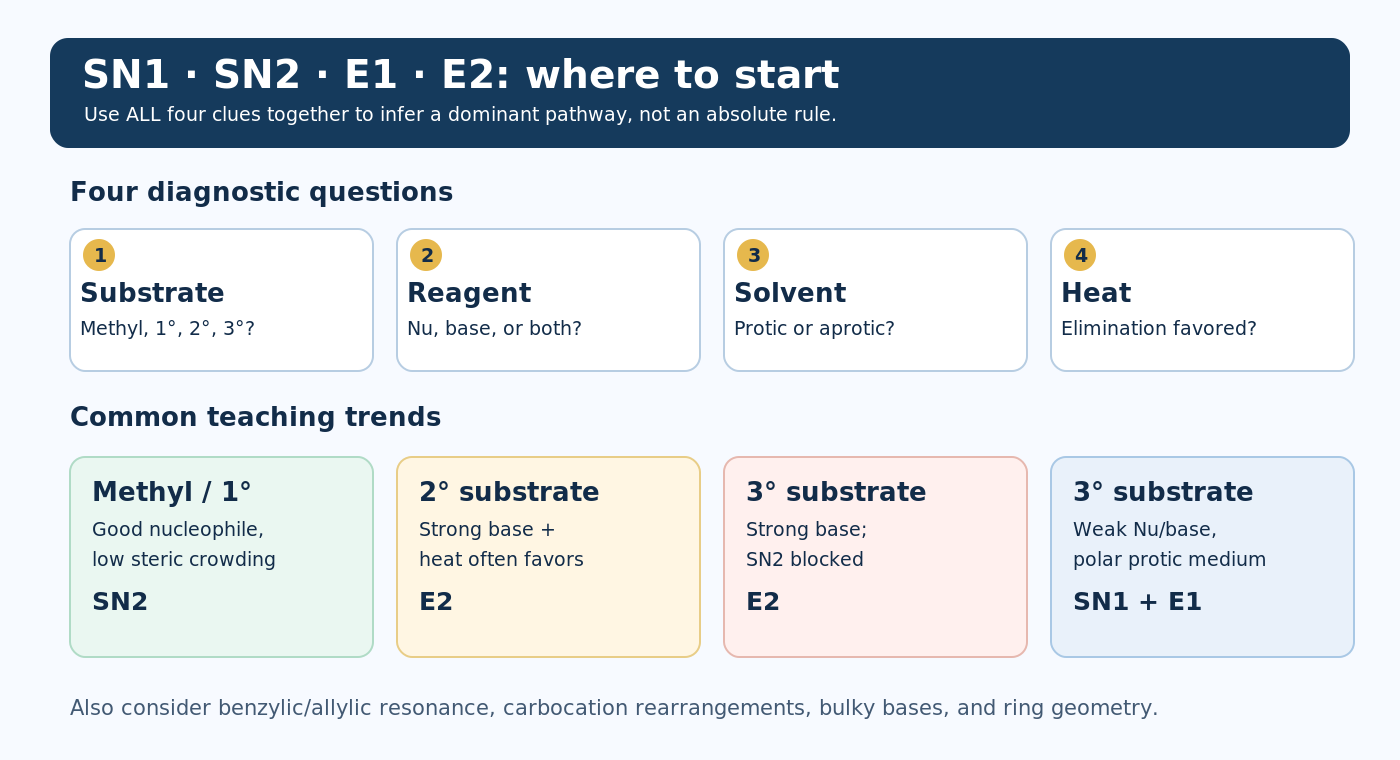
Four mechanisms compared
| Pathway | Typical conditions | Key mechanistic clue | Stereochemistry |
|---|---|---|---|
| SN1 | Carbocation-capable substrate; often weak nucleophile in polar protic medium | Ionization followed by nucleophilic attack | Often both faces accessible; exact racemization not guaranteed |
| SN2 | Unhindered substrate, strong nucleophile; often polar aprotic | Concerted backside attack | Inversion at reacting carbon |
| E1 | Carbocation-capable substrate, weak base, often heat | Ionization followed by loss of a β-H | Can compete with SN1; rearrangement possible |
| E2 | Strong base with β-H available | Concerted β-H removal; anti geometry favored | Anti-periplanar alignment important |
2-Bromobutane + sodium ethoxide, heated
- A secondary bromide can undergo substitution or elimination.
- Ethoxide is a strong base and a useful nucleophile.
- Heating favors elimination; anti-periplanar geometry supports E2.
Answer: E2 is commonly favored; butene isomers form, with trans-2-butene often prominent. Some SN2 may compete.
tert-Butyl chloride in water
- Tertiary substrate strongly hinders SN2.
- Water is a weak nucleophile/base and a polar protic medium.
- Carbocation formation allows nucleophilic attack or proton loss.
Answer: SN1 and E1 can compete; tert-butanol and 2-methylpropene may be produced, depending on conditions.
Exam traps
- A strong nucleophile does not guarantee SN2 on a tertiary carbon.
- A protic solvent does not automatically mean SN1 for primary halides.
- SN1 products are not guaranteed to be exactly 50:50 enantiomers.
- A bulky base can change which alkene is favored.
- SN2 inversion does not necessarily change the R/S label.
Quick self-check
Why is a tertiary alkyl bromide unsuitable for an ordinary SN2 reaction?
The required backside approach is sterically blocked at a tertiary reaction center.
Interactive SN1 vs SN2 vs E1 vs E2: Choose the Pathway Practice
Apply what you have learned using immediate feedback.
Interactive organic chemistry practice
SN1, SN2, E1 or E2?
Predict the dominant pathway under the stated conditions. Some reactions genuinely involve competing SN1 and E1 pathways; that is one answer option. These are selected teaching examples, not a universal reaction predictor.
Loading a practice case…
First-try correct: 0 / 0