
SN2 Stereochemistry: Inversion Explained
Learn what inversion means, why R does not always become S, and how to redraw products correctly.
What does inversion mean?
In an SN2 reaction, nucleophile attack and leaving-group departure happen in one step. The nucleophile approaches from the side opposite the leaving group, so the three-dimensional arrangement at the reacting carbon inverts. This is called Walden inversion.
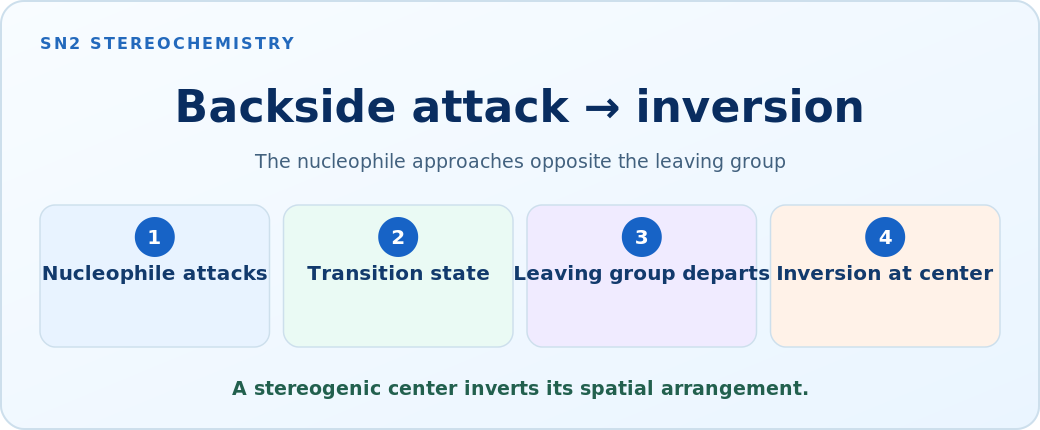
Three steps for a stereochemical product
- Identify the reacting carbon and the leaving group.
- Replace the leaving group with the attacking nucleophile from the opposite face, keeping the remaining bonds connected.
- Determine the product CIP priorities afresh before assigning R or S.
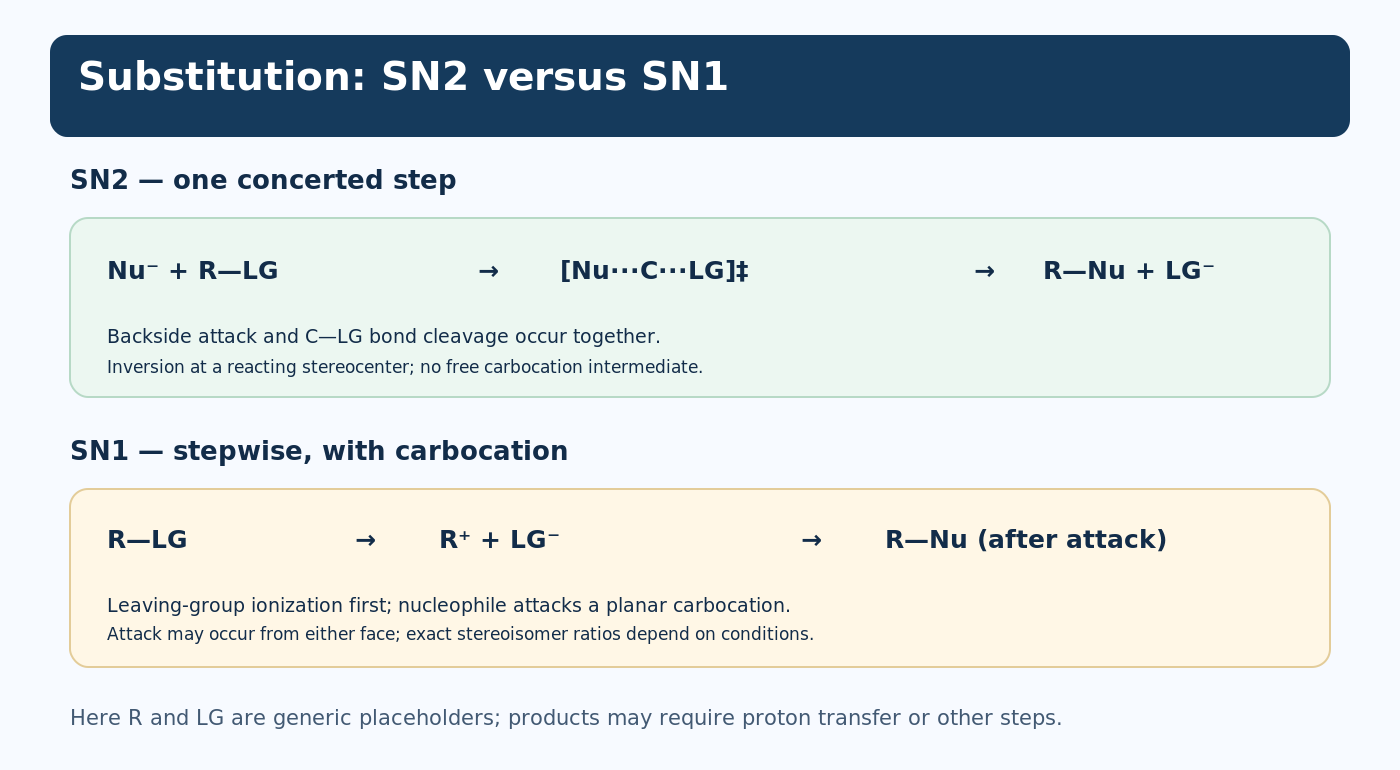
Compare substitution mechanisms
Worked stereochemistry reasoning
(R)-2-Bromobutane with NaSH in DMSO
- The secondary substrate can be attacked by hydrosulfide ion; polar aprotic DMSO supports the nucleophile.
- The nucleophile attacks carbon 2 from the opposite face while Br leaves.
- Draw the inverted three-dimensional product, but reassign CIP priorities after replacing Br by SH.
Answer: Butan-2-thiol forms as the substitution product with inversion of geometry at C2; determine its formal R/S descriptor using the product priorities.
By contrast, an SN1 carbocation is approximately planar, so attack from either side can give more than one stereoisomer. Ion pairs and solvent cages may make the distribution unequal.
Common mistakes
- Automatically writing “R becomes S” without checking product priorities.
- Drawing a planar carbocation intermediate for an SN2 step.
- Forgetting that tertiary alkyl halides generally cannot undergo ordinary SN2 substitution.
Try it yourself
Does SN2 always produce an S product from an R starting material?
No. The geometry inverts, but the CIP priority order may change when the substituent changes.