
Ethers & Williamson Ether Synthesis
Learn why a primary electrophile and a strong alkoxide form an ether by an SN2 pathway.
1. Understand the concept
An ether has an R–O–R′ linkage. In the Williamson synthesis an alkoxide attacks a suitable alkyl electrophile via SN2, replacing its leaving group.
Learning goal: Learn why a primary electrophile and a strong alkoxide form an ether by an SN2 pathway.
2. Use a reliable prediction strategy
- Split the desired ether across one C–O bond into an alkoxide and an alkyl halide or sulfonate.
- Choose the less hindered partner, preferably methyl or primary, as the electrophile.
- Recognize that alkoxide formation and substitution are separate preparative steps.
- Check for competing E2 elimination when electrophiles are secondary or tertiary.
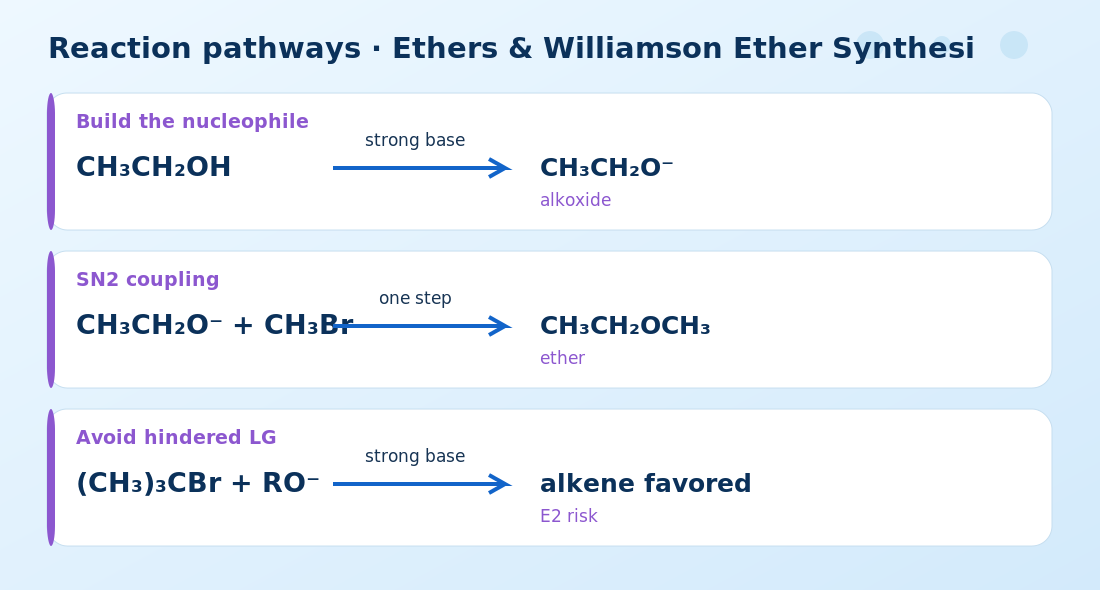
3. Follow the reaction roadmap
4. Work through examples
Ethyl methyl ether
CH₃CH₂O⁻ Na⁺ + CH₃Br → CH₃CH₂OCH₃ + NaBr
Ethoxide attacks an unhindered methyl electrophile by SN2.
Why tertiary halides fail
(CH₃)₃CBr + CH₃O⁻ → mainly elimination products
Tertiary electrophiles are too hindered for useful SN2; strong bases generally favor E2.
5. Common mistakes
- Trying to attack a tertiary alkyl halide with an alkoxide in an SN2 step.
- Forgetting that an alkoxide is an anion; a neutral alcohol alone is a much weaker nucleophile.
- Putting a tertiary carbon on the electrophile instead of the alkoxide partner.
6. Check understanding
Propose a Williamson route to methoxyethane using sodium ethoxide.
React sodium ethoxide with bromomethane or iodomethane: CH₃CH₂O⁻ + CH₃Br → CH₃CH₂OCH₃.
Why is tert-butyl bromide a poor electrophile for this process?
SN2 attack at a tertiary carbon is strongly hindered and the strong alkoxide tends to cause E2 elimination.
7. Practice the reactions
Use the quiz below to apply the rules to new substrates and reagents. A correct answer is explained, not merely marked.
Try the reaction challenge
Answer eight curated questions. Review the explanation after each answer.
Loading quiz…