
Uncertainty and Propagation
Measurements have limitations. Learn to describe the uncertainty of a result rather than presenting every calculated digit as equally reliable.
Propagate independent standard uncertainties for sums and differences, and describe assumptions behind the calculation.
1. What uncertainty means
Measurement uncertainty quantifies a specified range of plausible measured values under an explicit model. Instrument resolution, accuracy tolerances, and standard uncertainty are not interchangeable. Specify whether ± means a standard uncertainty, a tolerance, or an interval.
2. Differences from two readings
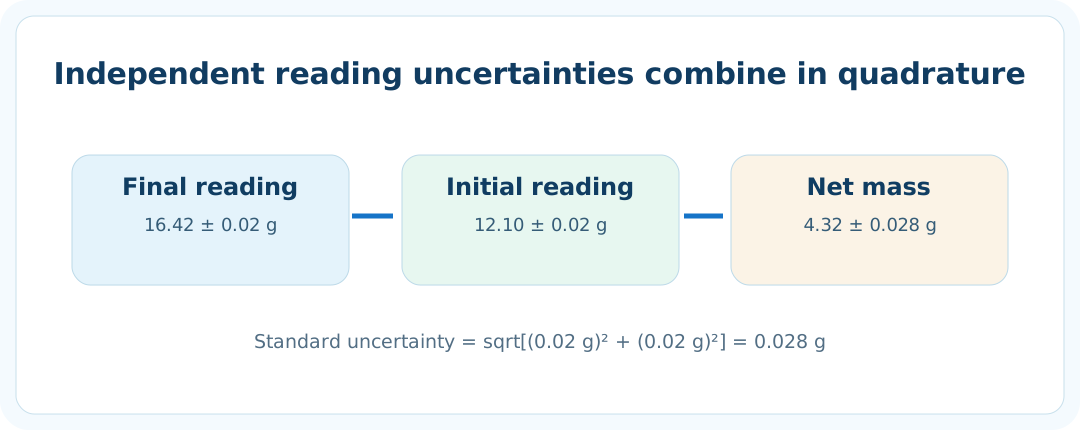
For a final reading 16.42 g and a tare reading 12.10 g, the difference is 4.32 g. This is commonly used for mass by difference and liquid dispensing.
3. Combine independent standard uncertainties
For z=a−b with independent standard uncertainties u(a) and u(b), u(z)=sqrt[u(a)²+u(b)²]. If both are 0.02 g, u(z)=0.0283 g, often reported as 0.03 g. Independence is an assumption: correlated calibration or drift errors may not cancel or combine this way.
4. Relative uncertainty and reporting
Relative standard uncertainty is 100 u(z)/|z|. In the example it is about 0.65%. Report the uncertainty with a sensible number of digits and round the result to the same decimal place as the uncertainty.
5. Document the uncertainty budget
Record independent contributors, estimates of each standard uncertainty, possible shared biases, and any expansion factors. Without those assumptions, a numerical ± value is incomplete.
Quick understanding check
Two independent mass readings each have standard uncertainty 0.02 g. What standard uncertainty is associated with their difference?
Reveal worked answer
sqrt(0.02²+0.02²)=0.0283 g, usually reported as about 0.03 g.