
GENERAL CHEMISTRY / 3D MOLECULES
VSEPR, Geometry & Molecular Polarity
Use central-atom electron domains and lone pairs to predict 3D shapes and bond-dipole cancellation.
Learning objectives
- Count central-atom electron domains correctly.
- Distinguish electron geometry from molecular geometry using AXE notation.
- Recognize when symmetric bonds cancel to yield nonpolar molecules.
1. Count regions, not bond lines
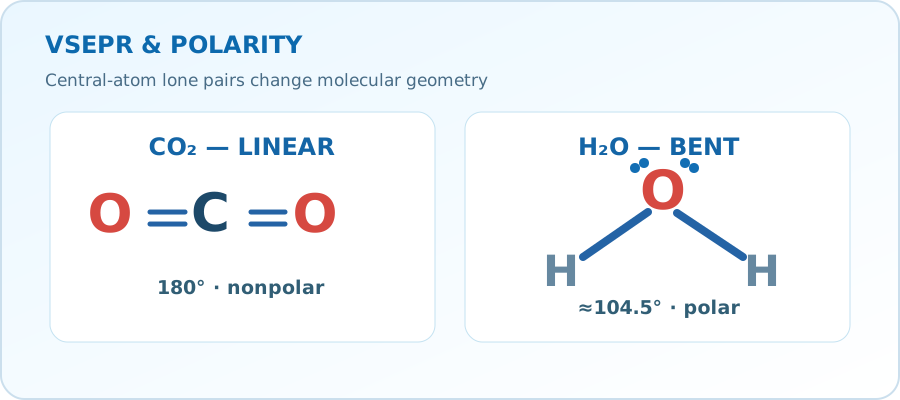
Each bond to a neighboring atom counts as one electron domain around the central atom, even if it is a double or triple bond. Each lone pair counts as an additional region. CO₂ therefore has two domains around C.
CO₂: two C=O double bonds → AX₂ → linear (180°).
2. Choose electron-domain geometry
Two, three, four, five, or six domains correspond ideally to linear, trigonal planar, tetrahedral, trigonal bipyramidal, and octahedral electron-domain geometries, respectively.
NH₃: four domains → tetrahedral electron geometry.
3. Remove lone pairs from the shape name
Molecular geometry describes the positions of bonded atoms, not the lone pairs. In NH₃ (AX₃E), the molecular geometry is trigonal pyramidal. H₂O (AX₂E₂) is bent.
H₂O: two bonding domains + two lone pairs → bent, about 104.5°.
4. Use angles as guides, not absolute rules
Ideal bond angles are 180°, 120°, 109.5°, 90°/120°, or 90° as appropriate. Lone pairs and chemical differences commonly distort real bond angles. Some compounds (such as solid PCl₅) have different structures in different phases.
SF₄: AX₄E → seesaw; deviations from ideal trigonal-bipyramidal angles.
5. Evaluate molecular polarity
First identify whether bonds are polar. Then consider their vector arrangement. A symmetric molecule with identical outer atoms may have cancelling dipoles. CO₂ is nonpolar, while bent H₂O is polar.
XeF₄: square planar with two opposite lone pairs; Xe–F dipoles cancel in the ideal geometry.
6. Rotate the interactive models
Use the Molecular Structure Viewer to compare ball-and-stick arrangements. These are simplified instructional models and do not replace measured experimental geometries.
Compare CH₄ (tetrahedral) and NH₃ (trigonal pyramidal).
Common mistakes
- Treating a double bond as two electron domains.
- Counting terminal-atom lone pairs when naming the central-atom geometry.
- Assuming every molecule with polar bonds has a net dipole.
- Treating idealized VSEPR angles as exact measurements.
Check your understanding
Why are CO₂ and H₂O different in molecular polarity?
Show explanation
CO₂ is linear and symmetric, so the C=O dipoles cancel. H₂O is bent, so the O–H dipoles have a net resultant.