
INTOCHEMISTRY / UNDERSTAND ELECTRON FLOW
E1: Carbocation Elimination
Distinguish two-step elimination from SN1 and concerted E2.
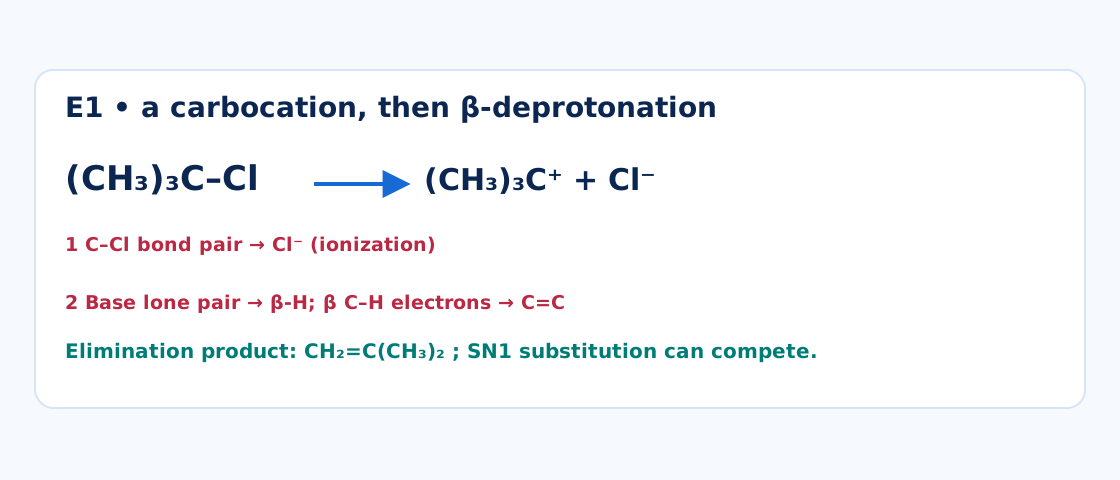
Trace ionization and beta deprotonation, predict plausible alkene products, and recognize the inevitable possibility of SN1 competition.
1The key idea
E1 has two main stages: leaving-group departure generates a carbocation, then a weak base removes a beta hydrogen and the electrons form a C=C bond. The ionization step is typically rate determining.
2Conditions and intermediates
Tertiary carbocations are often accessible in polar protic media with weak bases. Acid-catalyzed dehydration of tertiary alcohols can also proceed by E1 after protonation converts OH into water, a better leaving group.
3Draw the arrows in the right order
First draw a C–leaving group bond arrow to the leaving group. In a separate step, draw a base lone-pair arrow to the beta hydrogen and a C–H bond arrow toward the carbocation center to form the alkene.
4Products and competition
Often, the more substituted alkene is favored, but rearrangements, beta-hydrogen availability, and competing nucleophilic substitution can alter outcomes. Higher temperatures may increase elimination relative to substitution without guaranteeing a single exclusive product.
5Worked example
Heating 2-methyl-2-butanol with an acid catalyst gives mainly 2-methyl-2-butene within the alkene mixture. Protonate OH, lose water to form a tertiary carbocation, then remove a beta hydrogen to create C=C.
Common mistakes
- Drawing direct OH departure from an alcohol without prior protonation under acidic dehydration conditions.
- Showing all E1 electron-flow arrows in one concerted elementary step.
- Forgetting competing SN1 and possible carbocation rearrangements.
- Claiming temperature alone identifies a unique reaction mechanism.
Quick concept check
What mechanistic feature do E1 and SN1 share?
Show worked explanation
Both can begin with leaving-group departure to a carbocation; a nucleophile attacks in SN1, whereas a base removes a beta proton in E1.