
INTOCHEMISTRY / STEREOCHEMISTRY
Stereospecific E2 and Cyclohexanes
Understand anti-periplanar geometry and trans-diaxial ring elimination.
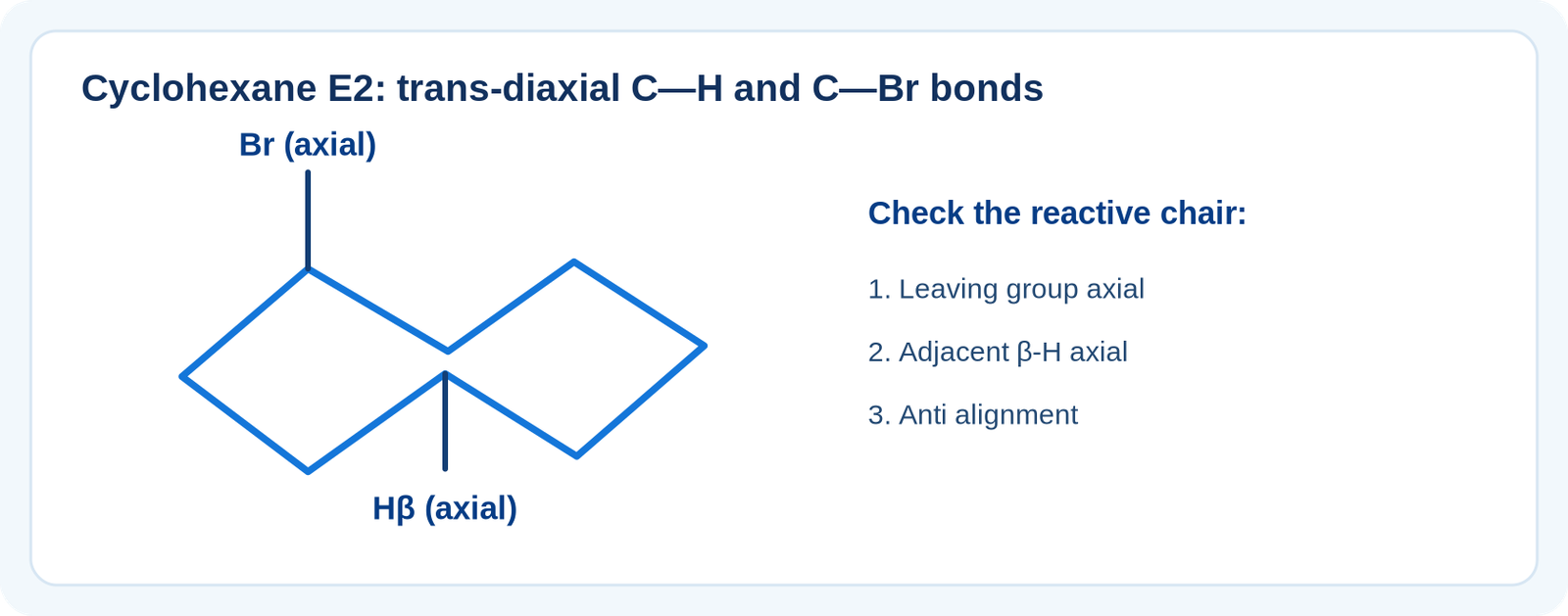
Determine which beta-hydrogens can be removed in E2 after examining real conformational constraints.
1The anti-periplanar requirement
The beta C–H bond and alpha C–leaving-group bond need appropriate orbital alignment. The favored concerted E2 geometry is anti-periplanar.
2Why E2 can be stereospecific
Rigid or conformationally constrained starting structures can lead to different alkene geometries or regiochemistry because only certain beta hydrogens are aligned.
3Cyclohexane requires trans-diaxial geometry
In cyclohexane chairs the leaving group and removable adjacent beta-hydrogen must be axial and anti. If the leaving group is equatorial, a ring flip may be necessary.
4Worked cis example
For cis-1-bromo-2-methylcyclohexane, the reactive chair with axial Br has equatorial C2-methyl, so an axial beta H is available at C2; 1-methylcyclohexene formation is geometrically possible.
5Worked trans example
For trans-1-bromo-2-methylcyclohexane, the reactive diaxial chair has Br and C2-methyl both axial: C2 has no axial beta H. Elimination toward C6 remains possible, yielding 3-methylcyclohexene from that geometry.
6Common error
Do not apply Zaitsev’s rule before checking whether the beta C–H bond can align correctly. Conformational availability can outweigh the more substituted alkene preference.
Concept check
An axial leaving group at C1 is anti to a C2 axial methyl substituent. Can E2 remove that methyl as if it were C2–H?
Reveal explanation
No. E2 requires an actual beta-hydrogen anti to the leaving group; check another adjacent carbon.