
Retrosynthesis: Planning Backward
Translate a target into possible precursors before choosing reagents.
Learning objective
Propose functional-group disconnections and verify a forward route.
1Start with the target
Mark the new bond, changed oxidation state, and location of each functional group. Working backward narrows the number of possible routes.
2Identify a precursor
For an alcohol, reasonable precursors include a carbonyl or an alkene. For an ether, inspect the two carbon–oxygen bonds and choose a viable Williamson disconnection.
3Test the forward chemistry
Every proposed step must respect substrate substitution, regioselectivity, stereochemistry, and functional-group compatibility.
4Evaluate competing processes
SN2 may compete with E2; carbocation pathways may rearrange; a strong oxidant may overoxidize a primary alcohol.
5Worked example: cyclohexene to cyclohexanone
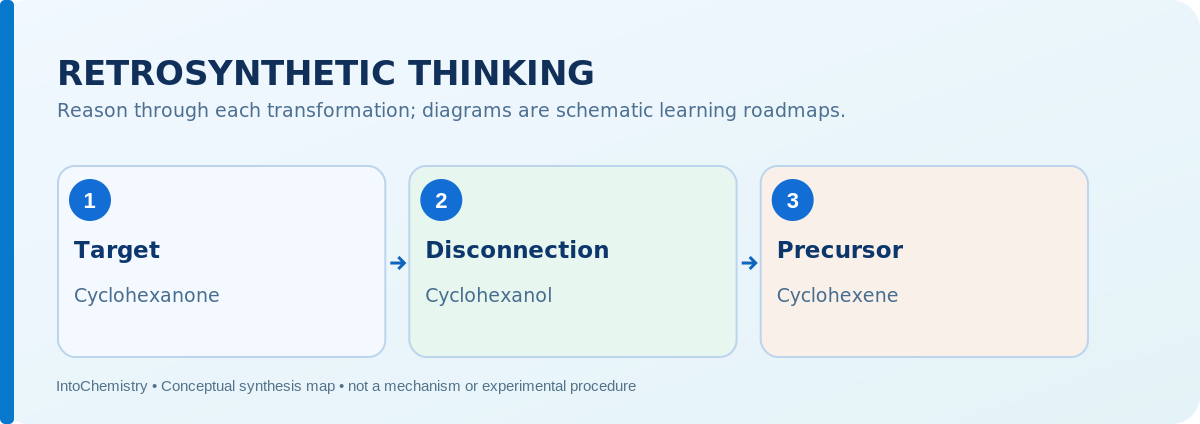
Retrosynthesis: cyclohexanone ⇐ cyclohexanol ⇐ cyclohexene. Forward: acid-catalyzed hydration gives cyclohexanol; PCC oxidizes it to cyclohexanone.
Check your understanding
Which route best converts cyclohexene into cyclohexanone?
Reveal explanation
Hydration to cyclohexanol, then controlled oxidation of the secondary alcohol. NaBH4 would reduce a ketone, not make it.