
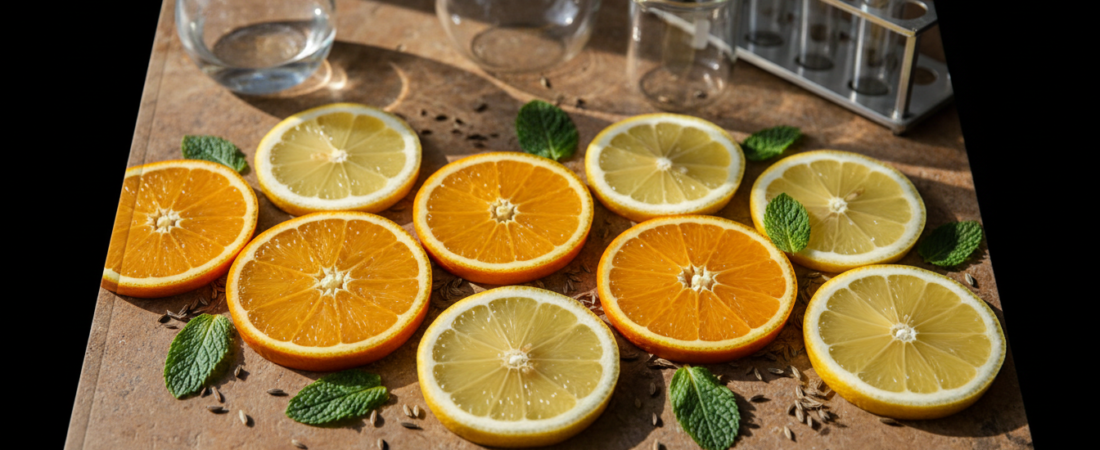
Do oranges and lemons smell different because their molecules are mirror images? It’s one of the most memorable stories told in introductory organic chemistry—and one that deserves a serious correction.
According to a popular version of the story, one enantiomer of limonene smells like oranges while its mirror-image form smells like lemons. The problem? Both fruits predominantly contain the same limonene enantiomer, and their recognizable aromas come from complex mixtures of volatile compounds.
This is much more than a trivial fact check. It’s an excellent case study in chirality, molecular recognition, analytical chemistry, and how scientists correct appealing but misleading explanations.
First: What Makes a Molecule Chiral?
A chiral object cannot be superimposed on its mirror image, even when you rotate it in three dimensions. Your left and right hands are familiar examples. Some molecules have the same kind of handedness because of the spatial arrangement of atoms around a stereogenic center.
A pair of molecules with the same bonding connectivity that are nonsuperimposable mirror images are called enantiomers. In an achiral setting they generally have the same melting point, boiling point, and many other bulk properties. But their interactions with chiral environments—including proteins and enzymes—can differ.
Where the Limonene Story Goes Wrong
Limonene is a terpene with molecular formula C₁₀H₁₆. It has a stereogenic center, so it can occur as (R)-limonene and (S)-limonene. The familiar claim says that (R)-limonene explains orange odor while (S)-limonene explains lemon odor.
Yet the essential oils of both lemons and oranges are typically dominated by (R)-limonene. Research published in the Journal of Chemical Education examined the literature and conducted odor testing, finding that the usual simple lemon-versus-orange stereochemistry explanation was not supported.
Read the research: Limonene in Citrus: A String of Unchecked Literature Citings?. A later 2025 scientific perspective also revisited the persistent confusion around limonene odors: The Persistent Myth of Limonene’s Smell.
If Not Opposite Enantiomers, Why Do Lemons and Oranges Smell Different?
The aroma of an essential oil is not a single molecule’s calling card. Citrus oils can contain many volatile components in different proportions. Relatively minor ingredients can strongly influence what you smell because odor thresholds and mixtures matter.
For example, citral—a mixture of the related aldehydes geranial and neral—contributes strongly to lemon-like notes. Orange oil has its own collection of odor-active compounds. Limonene is abundant in citrus peels, but its concentration alone does not predict the fruit’s entire aroma.

Can Enantiomers Really Smell Different? Yes.
The myth doesn’t invalidate the broader chemistry. Our odor receptors are proteins with three-dimensional, chiral binding environments. Two enantiomers can interact differently with a receptor, potentially creating different perceived aromas.
A classic educational example is carvone (C₁₀H₁₄O), another naturally occurring chiral molecule. (R)-carvone is associated with a spearmint aroma, while (S)-carvone is associated with caraway. Distinguishing these examples requires recognizing that “a particular pair of enantiomers can smell different” is not the same as “the aroma difference between two whole fruits must come from opposite enantiomers.”
Explore limonene and carvone’s chemical structures with PubChem. Look at each stereogenic center and confirm the assigned stereochemistry rather than trusting the common names.
How Did the Myth Become So Popular?
The explanation was simple, visual, and convenient for teaching. It appeared in books and secondary discussions and was repeated for years. The American Chemical Society’s Reactions series also acknowledged that it had repeated the claim, then released a correction: Citrus Scent DEBUNKED!.
This is a useful reminder that textbook examples should be held to the same standard of evidence as other scientific statements. Scientific understanding changes when experiments and better analyses challenge what seemed obvious.
The Difference Between a Compound and a Mixture
- Pure enantiomer: a single stereochemical form of a particular molecule.
- Essential oil: a complex natural mixture with many compounds at different concentrations.
- Odor threshold: the concentration at which a substance becomes perceptible under stated conditions.
- Perceived aroma: the combined result of receptor interactions, concentrations, mixture effects, and human variation.
A molecule present at a low percentage can still have a major effect on aroma if it is strongly odor-active. Conversely, a highly abundant component may not be the most distinctive part of a mixture’s scent.
Try the Stereochemistry Detective Challenge
- Use PubChem to find the structures of (R)- and (S)-limonene. Identify their stereogenic center and explain why the structures are mirror images but not superimposable.
- Examine the structures of (R)- and (S)-carvone. Identify the functional group in carvone that is absent from limonene.
- Explain why a pure-compound odor test cannot, by itself, establish what gives an entire natural essential oil its characteristic smell.
- Propose how gas chromatography–mass spectrometry and properly designed odor testing could help assess components of citrus oils.
A memorable chemistry story is a starting point for asking questions—not a substitute for checking the evidence.
The Takeaway for Organic Chemistry Students
Chirality matters tremendously in chemistry and biology. Enantiomers can behave differently in enzymes, drug targets, and smell receptors. But the lemon-and-orange limonene story illustrates a different lesson: the behavior of a mixture cannot always be explained by pointing to one familiar molecule.
If this scientific myth surprised you, explore another everyday organic chemistry example in our caffeine extraction guide, or visit IntoChemistry for more chemistry resources.
Original Scientific Sources
For further reading, consult the 2021 Journal of Chemical Education investigation, the 2025 perspective on limonene’s smell, and the American Chemical Society’s correction video.