

Caffeine is one of coffee’s most familiar compounds, but it is also an excellent example of organic chemistry in everyday life. Extracting caffeine from coffee brings together molecular structure, solubility, polarity, acid-base chemistry, partitioning, and purification.
For students, caffeine provides a useful bridge between chemical theory and a substance encountered in daily life. The same principles used to discuss caffeine extraction also appear in pharmaceutical chemistry, environmental analysis, food science, and laboratory research.
What is caffeine?
Caffeine is a naturally occurring organic compound produced by coffee, tea, cacao, guarana, and several other plants. It belongs to the methylxanthine family, a group of nitrogen-containing compounds related to the purine structure.
At the molecular level, caffeine contains several carbonyl groups and nitrogen atoms. These functional features influence how caffeine interacts with water, organic solvents, and other molecules. In its pure form, caffeine is a white crystalline solid with a bitter taste.
Why extracting caffeine is challenging
Coffee is a complex chemical mixture. In addition to caffeine, brewed coffee contains water, organic acids, sugars, aromatic compounds, oils, pigments, minerals, and plant compounds such as tannins.
A successful extraction must separate caffeine from these other substances without carrying too many impurities along with it. Chemists solve this problem by taking advantage of differences in chemical behavior rather than relying on a single property.
Solubility and polarity
The first important concept is solubility. Caffeine dissolves readily in hot water, which is why brewing transfers caffeine from ground coffee into the drink. Caffeine can also dissolve in selected organic solvents.
Caffeine is moderately polar. Its oxygen and nitrogen atoms can interact with water, while its ring system gives it compatibility with some less-polar organic liquids. The relative polarity of the solvent and the structure of the solute help determine where caffeine prefers to remain.
Temperature also matters. Hot water generally dissolves more caffeine than cold water, which is one reason brewing conditions affect the caffeine concentration of a cup of coffee.
Laboratory liquid-liquid extraction
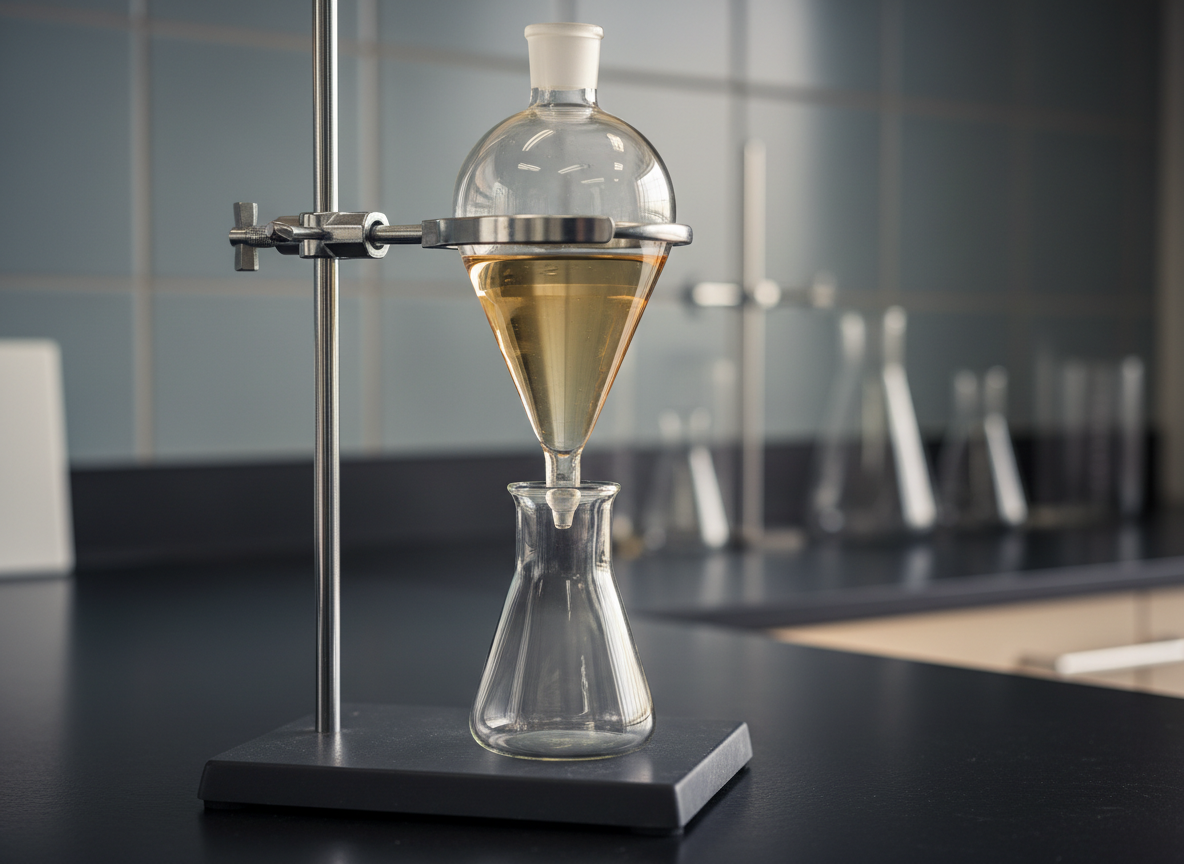
In a supervised laboratory demonstration, brewed coffee can be contacted with an immiscible organic solvent. Immiscible liquids do not form one uniform phase, so the mixture separates into two layers after it rests.
Caffeine distributes between the water layer and the organic layer according to its relative solubility in each phase. The layer containing a greater proportion of caffeine can then be separated from the coffee mixture.
Several smaller extractions are often more efficient than one extraction using the same total volume of solvent. This is an application of partitioning: each extraction gives the solute another opportunity to move into the phase in which it is more soluble.
The role of acid-base chemistry
Coffee contains acidic compounds and tannins that can interfere with caffeine isolation. In some laboratory methods, a basic substance is used to keep acidic impurities in the aqueous layer while caffeine moves more readily into the organic layer.
This is an example of selective separation. Chemists consider not only whether a compound dissolves, but also whether its chemical form changes when the surrounding conditions change.
Purifying the caffeine extract
After the caffeine-containing layer has been separated, the solvent can be removed under controlled laboratory conditions. The remaining material may contain caffeine along with other extracted compounds.
Recrystallization can improve purity by taking advantage of differences in solubility at different temperatures. A compound dissolves in a hot solvent and then forms crystals as the solution cools, while some impurities remain dissolved or are removed during the process.
How commercial decaffeination works
Commercial decaffeination is different from extracting caffeine from a brewed cup of coffee. It usually takes place before roasting, while the beans are still green.
- Water-based methods: Water dissolves caffeine and other soluble compounds, followed by filtration or selective processing.
- Supercritical carbon dioxide: Pressurized carbon dioxide behaves like a solvent and can remove caffeine from moistened beans.
- Solvent-based methods: Carefully controlled food-processing solvents may be used to remove caffeine while preserving as much flavor chemistry as possible.
Each approach involves tradeoffs involving selectivity, flavor preservation, cost, energy use, and processing conditions. Decaffeinated coffee is not completely caffeine-free, but it contains substantially less caffeine than regular coffee.
What this teaches us about organic chemistry
- Functional groups: Caffeine’s carbonyl groups and nitrogen atoms influence its polarity and intermolecular interactions.
- Intermolecular forces: Attractions between caffeine, water, and organic solvents affect how the compound partitions.
- Solubility: Temperature and solvent choice determine how much caffeine dissolves.
- Partitioning: A solute can distribute between two immiscible liquid phases.
- Acid-base chemistry: Chemical conditions can change how impurities behave during separation.
- Purification: Evaporation and recrystallization can produce a cleaner sample.
Safety considerations
Caffeine extraction demonstrations should be performed only with appropriate laboratory supervision, protective equipment, ventilation, and approved procedures. Some organic solvents can be toxic, flammable, or harmful to the environment. They should never be handled casually or disposed of down a drain.
For independent learners, it is safer to study the concepts through approved classroom demonstrations, simulations, or supervised laboratory activities rather than attempting an unsupervised solvent extraction.
Conclusion
Caffeine extraction shows how the structure of a molecule determines its behavior. By applying solubility, polarity, partitioning, acid-base chemistry, and purification, chemists can isolate a familiar compound from a complex natural mixture.
To explore more molecules, functional groups, reactions, and separation techniques, visit our Organic Chemistry page.
Continue with free chemistry practice
Connect the extraction discussion to the laboratory techniques used to analyze organic samples. TLC and Rf calculations · IR and GC evidence practice.