
Thin-Layer Chromatography: TLC & Rf Values
Understand normal-phase TLC, calculate Rf values and choose an effective solvent system.
Understand the concept
Thin-layer chromatography separates substances through differences in interactions with a stationary phase and a moving solvent. On silica gel TLC, which is relatively polar, more strongly adsorbed compounds often travel less far in the same nonpolar eluent.
The retention factor is Rf = (distance traveled by spot) ÷ (distance traveled by solvent front). Both distances start at the same baseline; Rf is dimensionless and generally between 0 and 1.
A reliable four-step approach
- Draw a pencil baseline above the solvent level.
- Spot samples on the baseline and allow them to dry.
- Develop the plate and mark the solvent front promptly.
- Measure baseline-to-spot-center and baseline-to-front distances; divide to find Rf.
Visual explanation
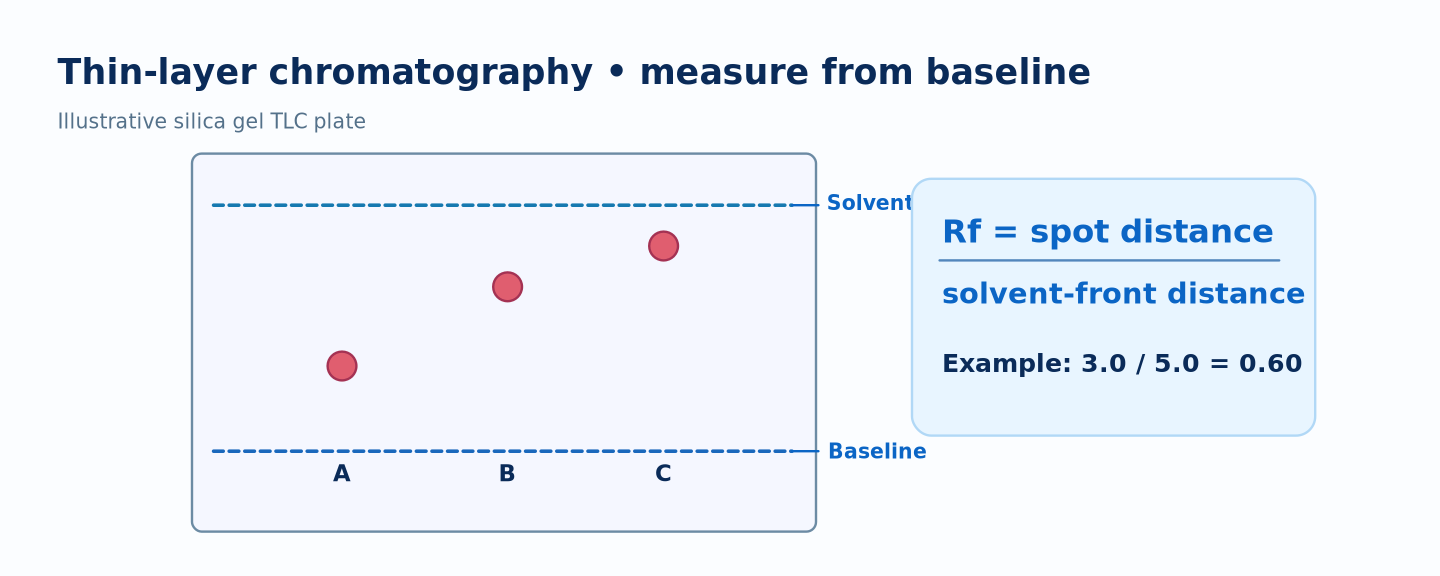
Work through the examples
A TLC spot center is 3.0 cm above baseline; the solvent front is 5.0 cm above the same baseline.
Divide distances measured from the baseline: Rf = 3.0 cm / 5.0 cm. The centimeters cancel.
Result: Rf = 0.60.
Two substances run on silica TLC using a relatively nonpolar solvent. Spot A has Rf 0.25, spot B has Rf 0.75.
Spot A moved less relative to the front and was retained more strongly by the silica under these conditions. This suggests stronger interaction with the polar stationary phase.
Result: A is more strongly retained on the silica under these conditions.
Common mistakes
- Measuring from the bottom edge rather than the pencil baseline.
- Drawing the baseline in ink, which can dissolve.
- Comparing Rf values obtained with different eluents as if they were directly transferable.
Check your understanding
A spot travels 2.4 cm, and the solvent front travels 6.0 cm. What is Rf?
Rf = 2.4 / 6.0 = 0.40.
Complete the interactive practice below to check more questions and review explanations.
Interactive Practice
Answer curated questions, then review the scientific explanation.
Loading practice questions…