
Alkyne Reactions & Selective Reduction
Differentiate cis and trans partial reductions and predict terminal-alkyne hydration products.
1. Understand the concept
Alkynes contain a C≡C triple bond. Their pi bonds allow selective reductions and hydration reactions; reagent choice strongly affects the final product.
Learning goal: Differentiate cis and trans partial reductions and predict terminal-alkyne hydration products.
2. Use a reliable prediction strategy
- Decide whether the reagent is reducing, hydrating, or adding across the triple bond.
- For partial reduction, H₂/Lindlar produces a cis alkene and Na/NH₃(l) produces a trans alkene when geometric isomers exist.
- For terminal-alkyne hydration, Hg²⁺ acid hydration typically gives a methyl ketone after tautomerization.
- For terminal-alkyne hydroboration–oxidation with a suitable bulky borane, the product is an aldehyde after tautomerization.
3. Follow the reaction roadmap
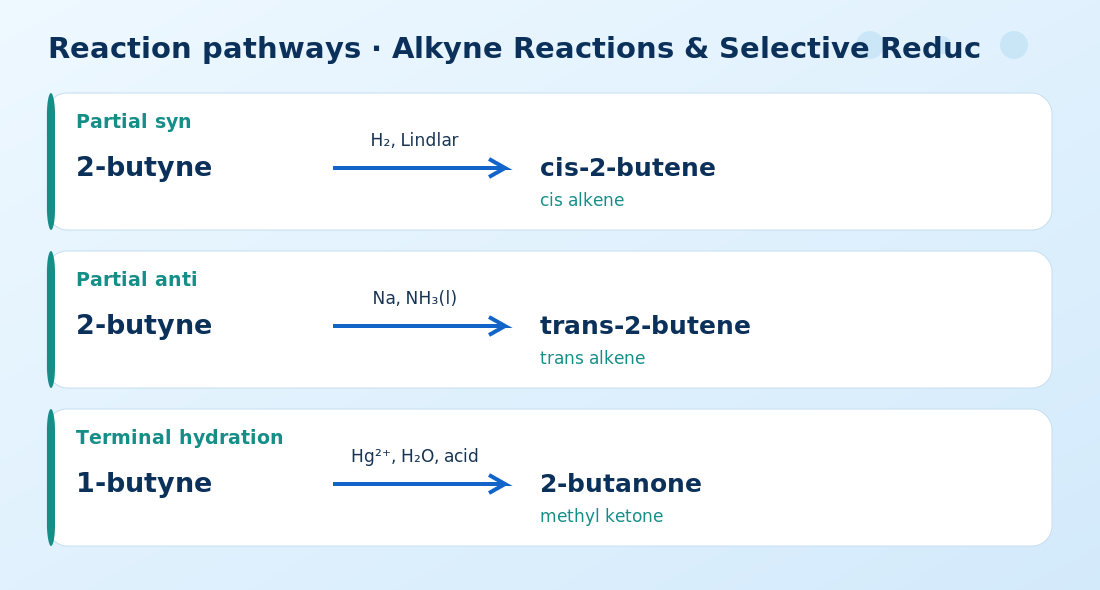
4. Work through examples
2-Butyne selective reduction
CH₃C≡CCH₃ + H₂/Lindlar → cis-2-butene
Catalyst-poisoned hydrogenation adds hydrogen syn and stops at an alkene.
1-Butyne hydration
CH₃CH₂C≡CH + HgSO₄/H₂SO₄/H₂O → CH₃CH₂COCH₃
Markovnikov hydration forms an enol that tautomerizes to the methyl ketone 2-butanone.
5. Common mistakes
- Calling the Lindlar product trans instead of cis when the two isomers are possible.
- Applying terminal-alkyne hydroboration as though it yields a ketone; anti-Markovnikov hydration gives an aldehyde.
- Forgetting that enols commonly tautomerize to carbonyl compounds.
6. Check understanding
Give two reagents that convert 2-butyne into different geometric alkene isomers.
Lindlar catalyst/H₂ gives cis-2-butene; Na/NH₃(l) gives trans-2-butene.
What carbonyl product comes from hydroboration–oxidation of 1-butyne?
Butanal, CH₃CH₂CH₂CHO, following enol-to-aldehyde tautomerization.
7. Practice the reactions
Use the quiz below to apply the rules to new substrates and reagents. A correct answer is explained, not merely marked.
Try the reaction challenge
Answer eight curated questions. Review the explanation after each answer.
Loading quiz…