
IntoChemistry · General Chemistry
Gas Laws: Boyle, Charles, and the Ideal Gas Equation
Select a gas law, convert temperature to kelvin, and solve with correct units.
◎ Clear explanations◉ Worked examples▤ Practice problems⬇ Free resources
What connects gas variables?
For many introductory problems, the pressure (P), volume (V), amount (n), and absolute temperature (T) of a gas are related by the ideal gas equation: PV = nRT. Simple gas laws describe how selected variables change when others are held constant.
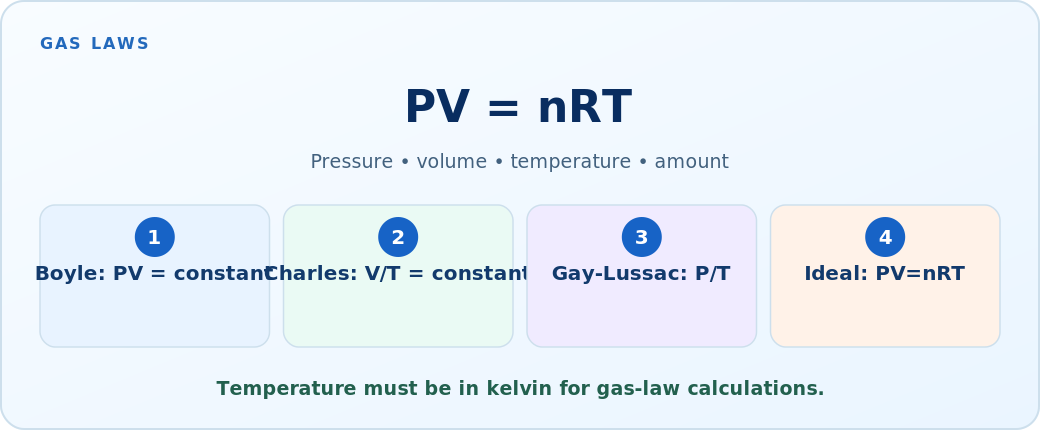
Choose the right law
| Law | Relationship | Conditions |
|---|---|---|
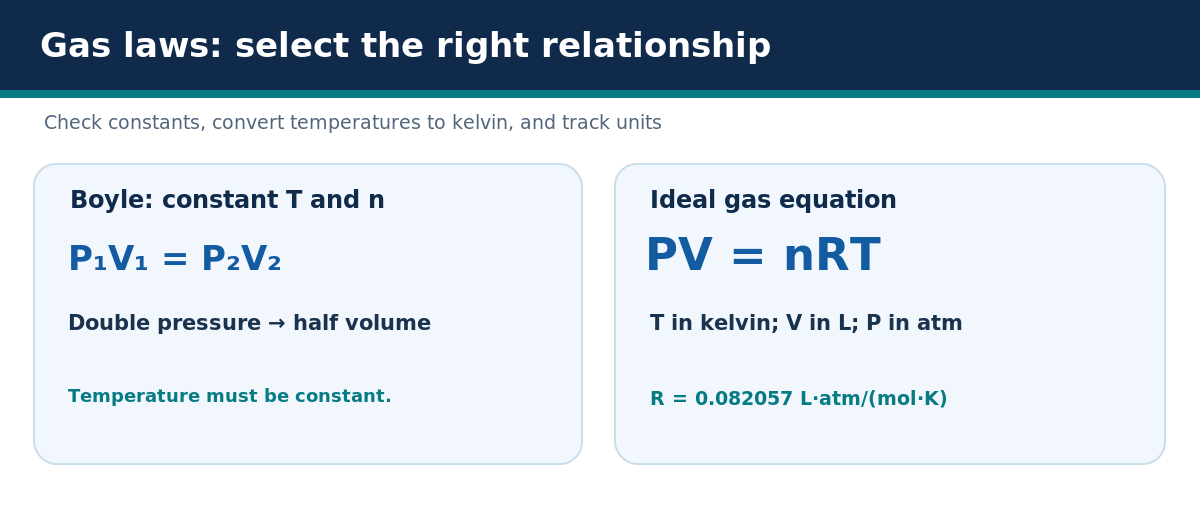
| Boyle | P₁V₁ = P₂V₂ | Constant T and n |
| Charles | V₁/T₁ = V₂/T₂ | Constant P and n |
| Gay-Lussac | P₁/T₁ = P₂/T₂ | Constant V and n |
| Combined | P₁V₁/T₁ = P₂V₂/T₂ | Constant n |
| Ideal gas | PV = nRT | Ideal-gas approximation |
Using P in atm and V in L, R = 0.082057 L·atm·mol⁻¹·K⁻¹.
Formula guide
Worked gas-law examples
Example 1
Boyle’s law
- At constant temperature, 1.20 atm of gas occupies 3.50 L.
- If pressure falls to 0.800 atm, use V₂ = P₁V₁/P₂.
- V₂ = (1.20 atm)(3.50 L)/(0.800 atm) = 5.25 L.
New volume: 5.25 L.
Example 2
Ideal gas law
- Find volume for 0.500 mol at 1.00 atm and 25.0°C.
- Convert temperature: 25.0 + 273.15 = 298.15 K.
- V = nRT/P = (0.500)(0.082057)(298.15)/1.00.
Volume ≈ 12.2 L (3 significant figures).
Important limits and mistakes
- Never put 25°C directly into a gas-law temperature ratio.
- Choose an R value consistent with the units provided.
- Real gases depart from ideal behavior, particularly under some high-pressure or low-temperature conditions.
- Gas volume depends on pressure and temperature; do not assume a universal molar volume without defining the conditions.
Check yourself
If gas pressure doubles at constant n and T, what happens to volume?
Volume is halved. Boyle’s law predicts an inverse relationship.
Interactive Gas Laws: Boyle, Charles, and the Ideal Gas Equation Practice
Apply what you have learned using immediate feedback.
Gas laws practice
Practice with a curated chemistry question bank. Check your result, read the explanation, then try another.