
INTOCHEMISTRY / CONFORMATION LESSON
Cyclohexane E2: Trans-Diaxial Requirement
Check geometry before applying Zaitsev or Hofmann trends.
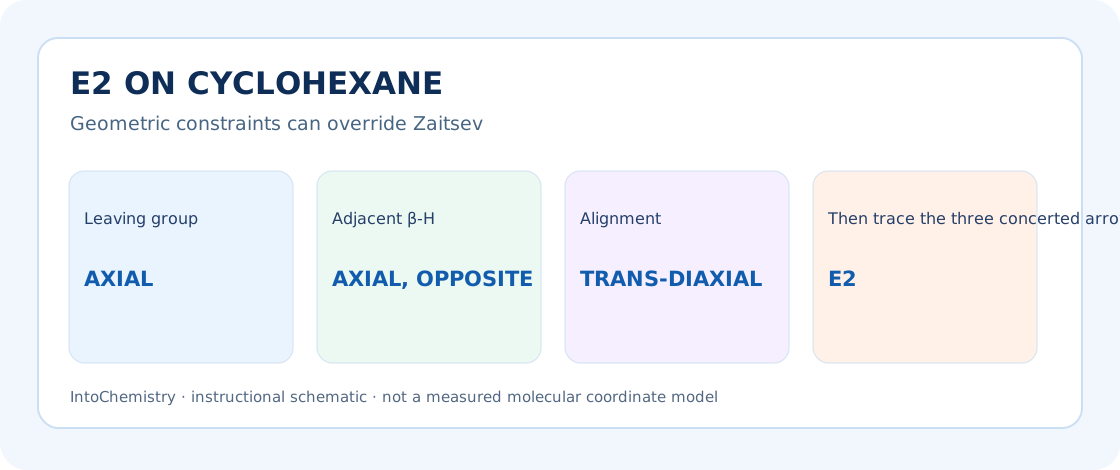
Identify chairs that expose an axial leaving group and an adjacent anti axial beta hydrogen.
1Identify the leaving group
On chair cyclohexane, the leaving group must be axial for the usual trans-diaxial E2 pathway. An equatorial leaving group is not directly aligned in that chair.
2Find a beta hydrogen
The adjacent carbon must bear an axial H oriented opposite the leaving group. If that position contains a substituent or no H, that pathway cannot proceed from the drawn chair.
3Check the ring flip
An accessible chair flip may move an equatorial leaving group axial; the actual reactive conformer and available beta H control the alkene outcome.
4Worked example
For bromocyclohexane in a chair with axial Br up at C1, adjacent C2 has an axial-down H if unsubstituted. These bonds are trans-diaxial, so E2 can form cyclohexene under appropriate strong-base conditions.
Check your reasoning
Can an equatorial bromine on a chair cyclohexane undergo the preferred E2 directly in that same chair?
Reveal the explanation
No. A ring flip (if accessible) or another suitable reactive conformation must position bromine axial and provide an adjacent trans-diaxial beta H.