
Multistep Organic Synthesis: Reaction Roadmaps
Learn to plan transformations backward from the target molecule and verify each step.
1. Understand the concept
Multistep synthesis combines reactions into a sequence. The key skill is to map functional-group changes and choose reagents that work with the starting material and intermediates.
Learning goal: Learn to plan transformations backward from the target molecule and verify each step.
2. Use a reliable prediction strategy
- Compare the target and starting material: carbon skeleton, functional groups, and stereochemistry.
- Work backward one transformation at a time (retrosynthesis).
- Choose forward reagents using known selectivity and compatibility.
- Check whether each proposed intermediate is accessible and whether a competing pathway dominates.
3. Follow the reaction roadmap
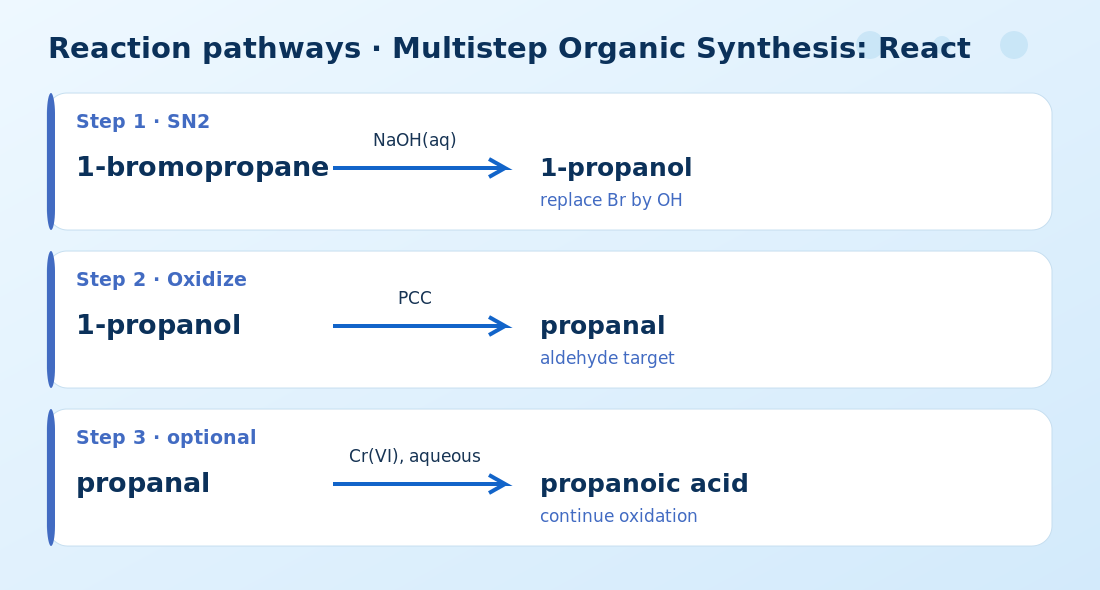
4. Work through examples
Primary alkyl bromide to aldehyde
CH₃CH₂CH₂Br →(aq. NaOH) CH₃CH₂CH₂OH →(PCC) CH₃CH₂CHO
First substitute bromide with hydroxide by SN2, then oxidize the primary alcohol under mild conditions.
Continue aldehyde to acid
CH₃CH₂CHO →(CrO₃/H₂SO₄/H₂O) CH₃CH₂CO₂H
Further oxidation converts the aldehyde into propanoic acid. Avoid choosing a reagent that would oxidize the intermediate too early.
5. Common mistakes
- Ignoring rearrangements or E2/SN2 competition while planning.
- Choosing harsh aqueous oxidizing conditions when an aldehyde is the target.
- Changing the carbon count unintentionally during a functional-group interconversion.
6. Check understanding
Write a two-step conversion of 1-bromopropane to propanal.
1-Bromopropane + aqueous NaOH → 1-propanol; then PCC in anhydrous solvent → propanal.
Why should Jones oxidation not be used for the second step when propanal is the target?
Aqueous Cr(VI) oxidation generally oxidizes primary alcohols beyond the aldehyde to the corresponding carboxylic acid.
7. Practice the reactions
Use the quiz below to apply the rules to new substrates and reagents. A correct answer is explained, not merely marked.
Try the reaction challenge
Answer eight curated questions. Review the explanation after each answer.
Loading quiz…