
Radical Reactions: Peroxides & Halogenation
Understand radical chains, HBr peroxide regioselectivity, and selectivity in radical halogenation.
1. Understand the concept
Radical reactions involve species with unpaired electrons. Typical chain reactions have initiation, propagation, and termination steps.
Learning goal: Understand radical chains, HBr peroxide regioselectivity, and selectivity in radical halogenation.
2. Use a reliable prediction strategy
- Recognize radical initiators such as peroxides and light where appropriate.
- For alkene + HBr with peroxides, use the radical chain that normally leads to anti-Markovnikov HBr addition.
- For ordinary ionic HBr addition without peroxides, predict Markovnikov regioselectivity.
- For alkane halogenation, evaluate possible hydrogen abstraction sites; a mixture of products is common.
3. Follow the reaction roadmap
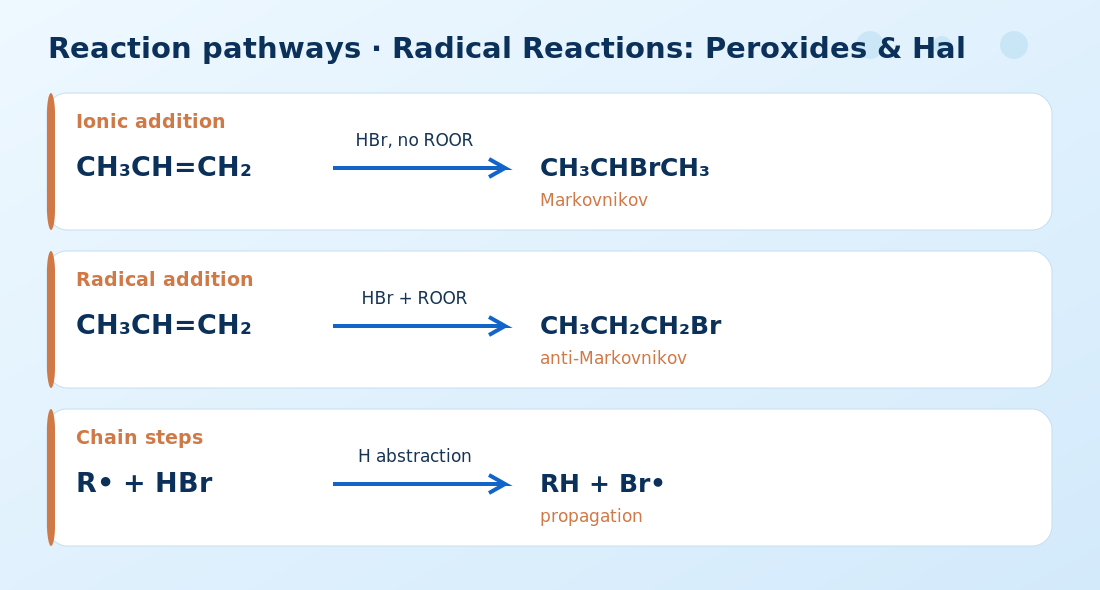
4. Work through examples
Propene + HBr + peroxide
CH₃CH=CH₂ + HBr/ROOR → CH₃CH₂CH₂Br
The radical chain favors 1-bromopropane (anti-Markovnikov). This peroxide effect is characteristic of HBr, not a universal rule for HX.
Propene + HBr, no peroxide
CH₃CH=CH₂ + HBr → CH₃CHBrCH₃
Ordinary electrophilic addition gives 2-bromopropane under typical conditions.
5. Common mistakes
- Extending the peroxide effect equally to HCl and HI; chain energetics make this unreliable.
- Calling every bromination radical; Br₂ added to an alkene without light/peroxide usually proceeds via bromonium-ion electrophilic addition.
- Treating radical alkane chlorination as a perfectly selective single-product synthesis.
6. Check understanding
Compare HBr addition to propene with and without peroxides.
Without peroxides 2-bromopropane is expected; with ROOR, 1-bromopropane is favored by radical addition.
Why might radical monochlorination of butane form more than one structural product?
Butane has primary and secondary C–H positions, giving 1-chlorobutane and 2-chlorobutane (and stereoisomeric products where relevant).
7. Practice the reactions
Use the quiz below to apply the rules to new substrates and reagents. A correct answer is explained, not merely marked.
Try the reaction challenge
Answer eight curated questions. Review the explanation after each answer.
Loading quiz…