
Solution Dilution: C₁V₁ = C₂V₂ Explained
Calculate how much stock solution to transfer when preparing a new concentration.
What changes during a dilution?
When solvent is added without adding or removing solute, the number of moles of dissolved solute stays the same. As the total solution volume increases, molarity decreases. This gives the convenient relationship C₁V₁ = C₂V₂ (equivalently M₁V₁ = M₂V₂ for molarity).
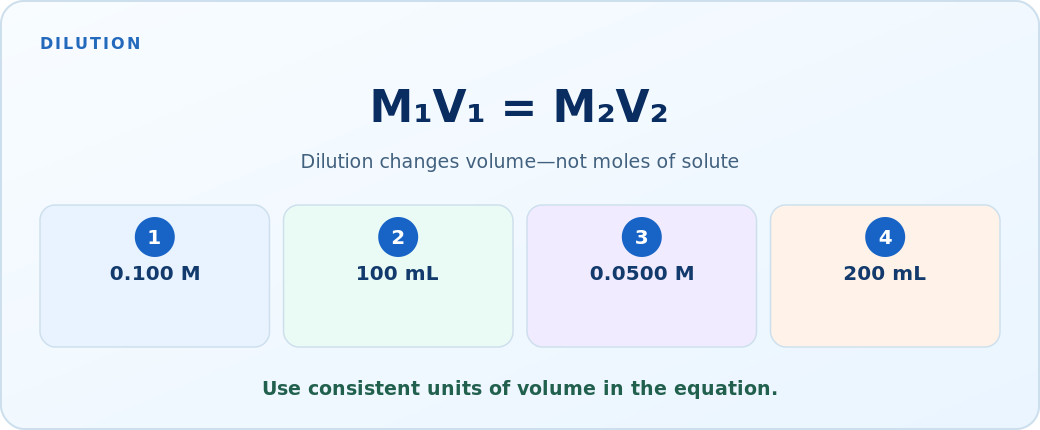
How to prepare a dilution
- Identify stock concentration C₁ and desired final concentration C₂ and volume V₂.
- Solve V₁ = C₂V₂/C₁ using consistent volume units.
- Measure V₁ of stock solution with suitable volumetric equipment.
- Transfer to a volumetric flask of capacity V₂, add appropriate solvent below the mark, mix, then bring precisely to the final mark and invert to homogenize.
Follow applicable laboratory safety procedures. When working with concentrated acids, follow the acid-to-water rule and validated preparation procedures.
See the difference between aliquot and final volume
Worked calculations
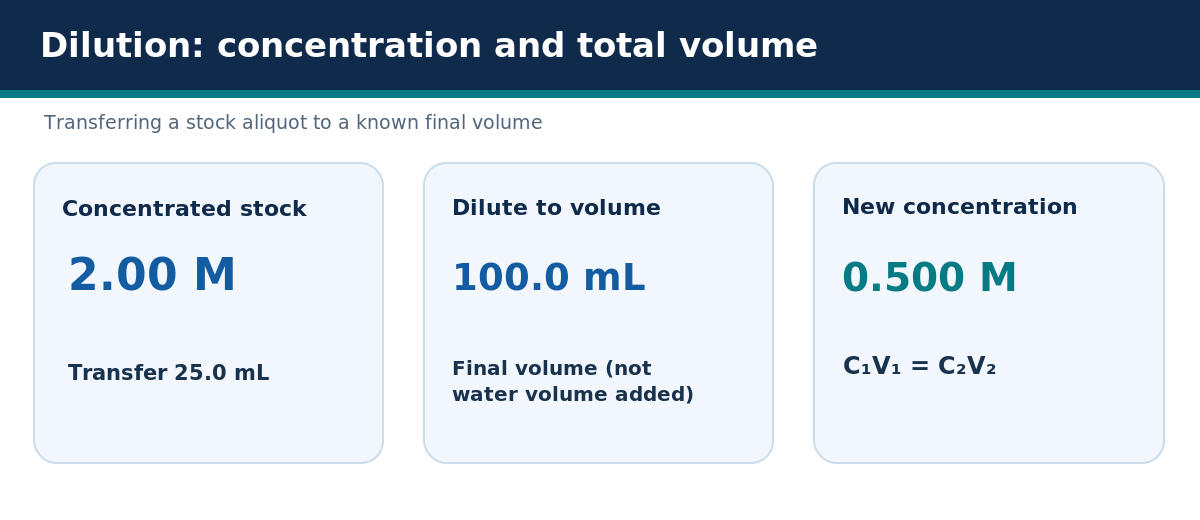
Prepare 100.0 mL of 0.500 M solution from 2.00 M stock
- C₁ = 2.00 M; C₂ = 0.500 M; V₂ = 100.0 mL.
- V₁ = (0.500 × 100.0)/2.00 = 25.0 mL.
Transfer 25.0 mL stock and dilute to 100.0 mL total solution.
Prepare 250.0 mL of 1.50 M solution from 6.00 M stock
- V₁ = C₂V₂/C₁.
- V₁ = (1.50 × 250.0)/6.00 = 62.5 mL.
Measure 62.5 mL stock and bring final solution volume to 250.0 mL.
Potential sources of error
- Confusing volume of diluent added with the final solution volume.
- Mixing liters with milliliters within the same equation without converting.
- Using inappropriate measuring equipment or failing to mix thoroughly.
- Assuming all mixing processes are strictly volume-additive: the dilution equation only requires an accurately established final solution volume.
Quick check
What volume of 1.00 M stock is needed for 500.0 mL of 0.100 M solution?
V₁ = (0.100 × 500.0) / 1.00 = 50.0 mL stock. Dilute to 500.0 mL final volume.
Interactive Solution Dilution: C₁V₁ = C₂V₂ Explained Practice
Apply what you have learned using immediate feedback.
Dilution calculations
Practice with a curated chemistry question bank. Check your result, read the explanation, then try another.