
INTOCHEMISTRY / STEREOCHEMISTRY
SN1 Product Stereochemistry
Explain planar carbocations, two-face attack, and ion-pair effects.
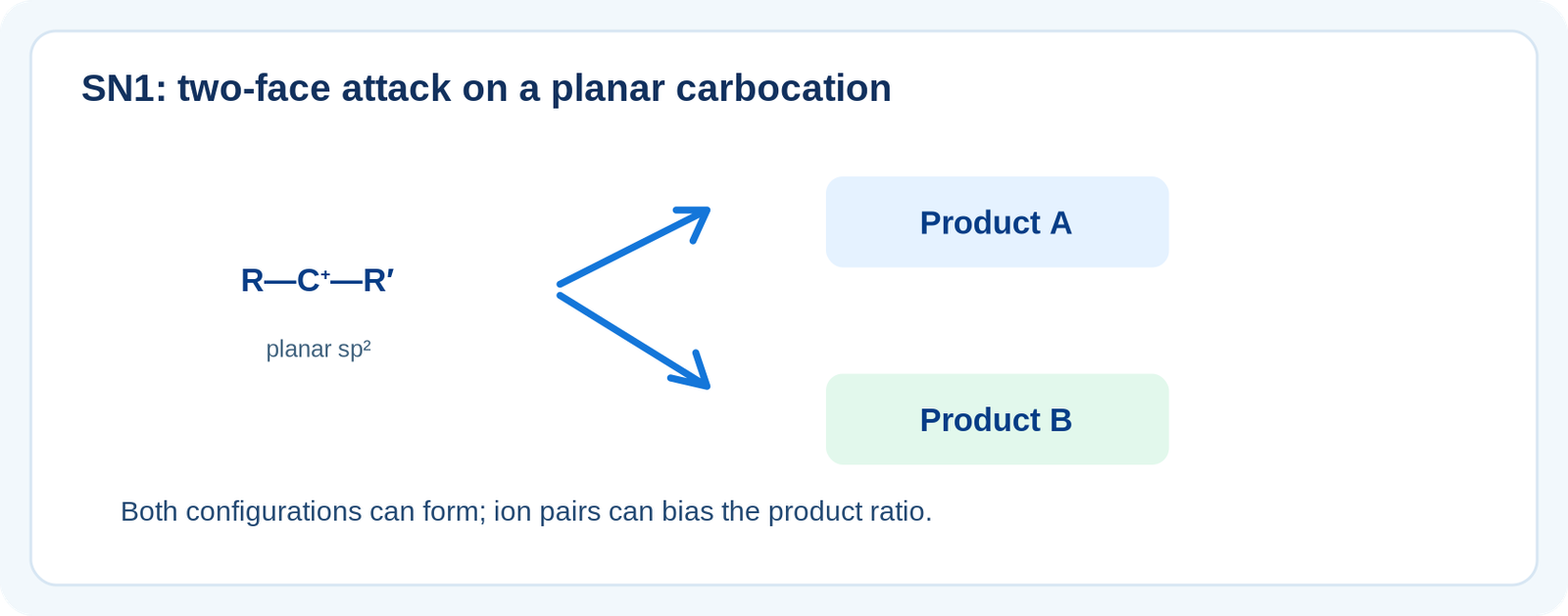
Describe why substitution through a planar carbocation may generate both product configurations without assuming exact 50:50 ratios.
1Ionization
SN1 begins with departure of the leaving group to make a carbocation; this is typically the rate-determining step.
2Planar carbocation
The reactive positively charged carbon is approximately trigonal planar. When nucleophilic addition makes a stereogenic center, attack may occur from either face.
3Worked example
An enantioenriched benzylic secondary alkyl bromide reacting by SN1 with water can give both configurations of the corresponding alcohol after deprotonation.
4Why not exactly 50:50?
Contact ion pairs and solvent-cage effects can block one face and give partial rather than perfect racemization.
5Recognize nonchiral products
A planar intermediate does not guarantee two enantiomers: tert-butyl bromide solvolysis produces achiral tert-butanol.
6Competing pathways
E1 can accompany SN1 when beta hydrogens and conditions allow; the product discussion must specify that substitution is being considered.
Concept check
An SN1 reaction forms a planar carbocation. Is the mixture always precisely racemic?
Reveal explanation
No. Two-face attack is possible, but ion-pair and solvent-cage effects can give a non-50:50 ratio.