
¹H NMR: Chemical Shift, Integration & Splitting
Interpret chemical shifts, integrals and simple n + 1 splitting using a real ethyl acetate example.
Understand the concept
Proton NMR measures the magnetic environments of hydrogen nuclei. The horizontal axis is chemical shift δ (ppm), conventionally decreasing left to right. A signal’s integration reflects the relative number of hydrogens and its splitting can report neighboring hydrogens.
The n + 1 rule is most useful for straightforward first-order coupling between equivalent neighboring protons. Exchangeable O–H protons and complex systems often behave differently.
A reliable four-step approach
- Count distinct sets of chemically equivalent protons.
- Use integrals to find relative hydrogen counts for each signal.
- Use the approximate shift to identify neighboring functional groups.
- Check splitting patterns and connectivity with the n + 1 rule when appropriate.
Visual explanation
Work through the examples
Ethyl acetate, CH₃COOCH₂CH₃: assign its three main proton signals.
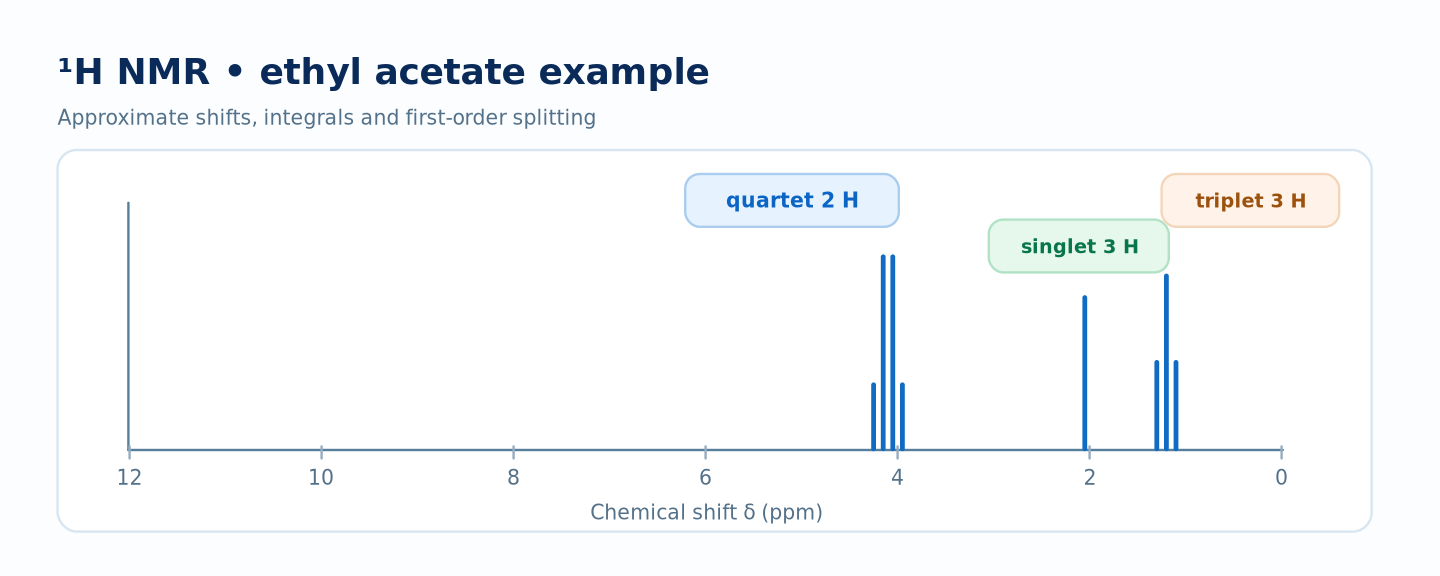
Acetyl CH₃ has no adjacent C–H protons across the carbonyl, so it is usually a singlet near δ 2.1 (3H). O–CH₂ is adjacent to CH₃, forming a quartet near δ 4.1 (2H). The terminal CH₃ couples to CH₂, making a triplet near δ 1.2 (3H).
Result: Approximate signals: 2.1 ppm singlet (3H), 4.1 ppm quartet (2H), 1.2 ppm triplet (3H).
A CH₃ group is directly next to a CH₂ group; both are simple first-order environments.
Three equivalent protons on CH₃ couple to the two neighboring CH₂ protons, giving three lines. Two protons on CH₂ couple to three neighboring CH₃ protons, giving four lines.
Result: Expect a CH₃ triplet and a CH₂ quartet.
Common mistakes
- Treating integral height as the same thing as integral area.
- Assuming every OH signal follows the n + 1 rule.
- Using splitting alone without checking chemical shift and molecular connectivity.
Check your understanding
In a simple ethyl group, how does a CH₃ next to CH₂ usually split?
Two adjacent equivalent CH₂ protons generally split the CH₃ into n + 1 = 3 lines.
Complete the interactive practice below to check more questions and review explanations.
Interactive Practice
Answer curated questions, then review the scientific explanation.
Loading practice questions…