
IntoChemistry · General Chemistry
Stoichiometry: A Step-by-Step Guide
Use balanced equations to convert between grams, moles and product amounts with a repeatable problem-solving process.
◎ Clear explanations◉ Worked examples▤ Practice problems⬇ Free resources
What is stoichiometry?
Stoichiometry relates reactant and product amounts using the coefficients of a balanced chemical equation. Coefficients are ratios of particles or moles—not grams.

The reliable five-step method
- Balance the chemical equation.
- Convert the given quantity into moles if needed.
- Apply the mole ratio from the balanced coefficients.
- Convert the result to grams, liters, or particles as requested.
- Check cancellation of units and significant figures.
Follow the calculation roadmap
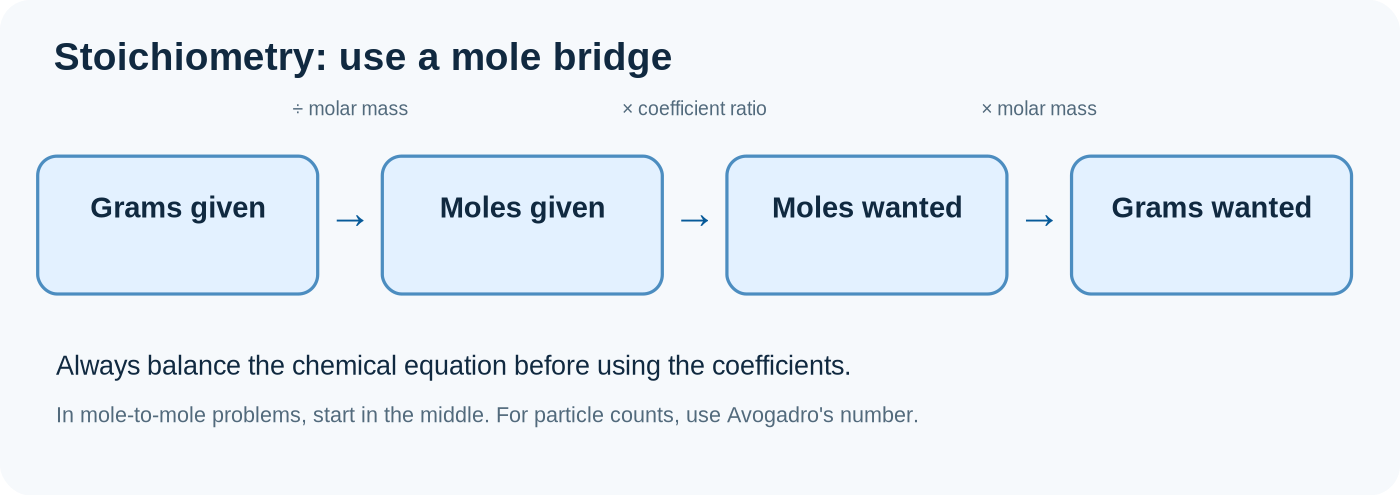
Worked stoichiometry examples
Worked example
How much water forms from 3.00 mol O₂ and excess H₂?
- Balance the equation: 2 H₂ + O₂ → 2 H₂O.
- Use the balanced mole ratio: 3.00 mol O₂ × (2 mol H₂O / 1 mol O₂).
- Verify O₂ cancels and the remaining unit is mol H₂O.
Answer: 6.00 mol H₂O.
Worked example
How many grams of CO₂ form from 8.00 g CH₄?
- Balance: CH₄ + 2 O₂ → CO₂ + 2 H₂O (oxygen in excess).
- Convert CH₄ to mol: 8.00 g ÷ 16.05 g/mol = 0.4984 mol.
- The CH₄:CO₂ coefficient ratio is 1:1.
- Multiply by the CO₂ molar mass, 44.01 g/mol.
Answer: 21.9 g CO₂ (three significant figures).
Worked example
Find the limiting reactant: 3.00 mol H₂ + 2.00 mol O₂
- Use 2 H₂ + O₂ → 2 H₂O.
- Reacting all 3.00 mol H₂ requires 1.50 mol O₂, which is available.
- Therefore, H₂ runs out first and controls product amount.
Answer: H₂ is limiting; 3.00 mol H₂O can form.
Common mistakes
- Using an equation before balancing it.
- Using molar masses in place of coefficient ratios.
- Skipping conversion from grams into moles.
- Choosing the excess reagent as the limiting reactant.
Quick self-check
Why is the mole ratio 2:1 for H₂O:O₂?
Because the balanced equation 2 H₂ + O₂ → 2 H₂O has coefficients 2 and 1 for those species.
Interactive Stoichiometry: A Step-by-Step Guide Practice
Apply what you have learned using immediate feedback.
Practice tool
Stoichiometry: Mole Ratios
All equations are balanced. Assume that any other reactant is available in excess. Give an answer in moles; three significant figures are sufficient.
Loading question…
Correct on first try: 0 / 0