
Significant Figures in Lab Reports
Correct answers require both chemistry and reporting conventions. The written value communicates precision.
Apply decimal-place and significant-figure reporting rules and preserve meaningful trailing zeros.
1. Significant digits and placeholders
In 0.00450, the first three zeros are placeholders; the digits 4, 5, and the final 0 are significant. In 2.50, the final zero communicates three significant figures, unlike 2.5.
2. Addition and subtraction
Round based on the least precise decimal position. For 12.11+0.3=12.41, the final reported sum is 12.4. Do not use the multiplication rule for addition.
3. Multiplication and division
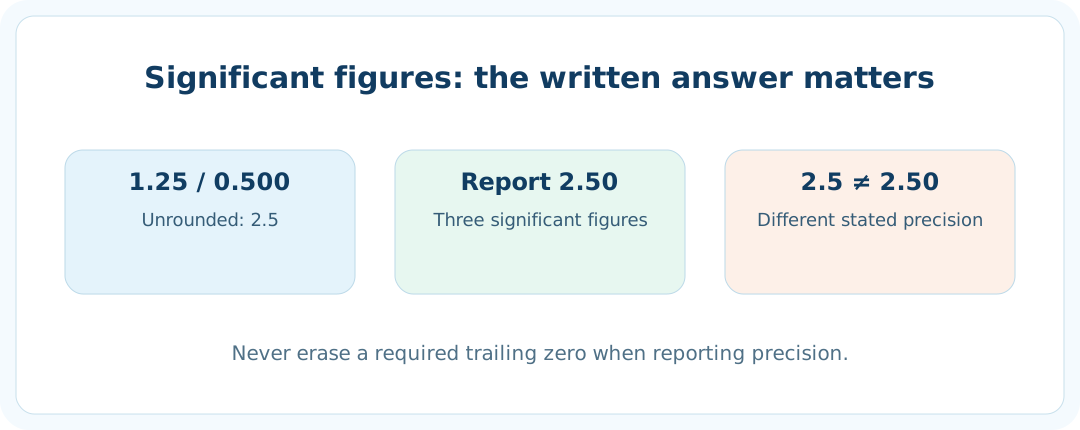
Round to the fewest significant figures among measured inputs. For 6.20 × 2.1=13.02, report 13 (two significant figures). For 1.25 / 0.500=2.5, report 2.50 (three significant figures).
4. Guard digits and exact numbers
Do not round early. Conversion definitions and exact count numbers generally do not limit significant figures. Scientific notation clarifies ambiguity, e.g., 1.30×10² contains three significant figures.
5. Significant figures do not replace uncertainty
Reporting conventions are useful introductory tools; an explicit uncertainty budget conveys more information about quality. Some tie-breaking policies differ. State the rounding convention when a value lies precisely halfway.
Quick understanding check
What is 1.25 / 0.500 reported to correct significant figures?
Reveal worked answer
2.50. Three significant figures are needed even though its numerical value equals 2.5.