
GENERAL CHEMISTRY / DELOCALIZATION
Resonance: One Structure, Multiple Contributors
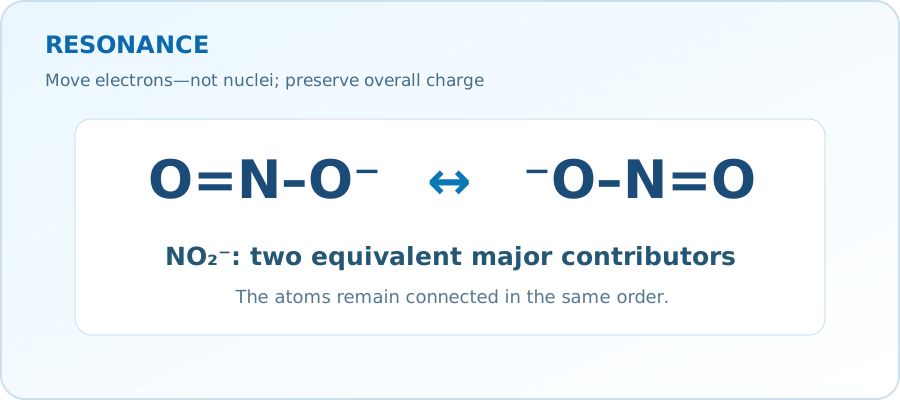
Represent electron delocalization without moving atomic nuclei or treating contributors as separate molecules.
Learning objectives
- Identify equivalent resonance contributors of common ions.
- Keep the atom connectivity and net charge unchanged.
- Explain why a resonance hybrid is not a rapid mixture of isolated contributors.
1. What resonance means
A Lewis structure may not represent a delocalized electron distribution with a single drawing. We use two or more resonance contributors to describe one underlying species. The atoms stay in the same positions; electrons are redistributed.
NO₂⁻: O=N–O⁻ ↔ ⁻O–N=O (each contributor includes one lone pair on N).
2. Move electrons, not atoms
Move π electrons or lone pairs while keeping the same σ-bond connectivity. Verify all changes obey the relevant valence and electron budget. An arrow between resonance contributors is ↔, not a reaction equilibrium arrow.
CO₃²⁻ has three equivalent major octet-satisfying contributors.
3. Maintain charge bookkeeping
The sum of formal charges must remain equal to the original total charge. In a nitrate contributor, N is +1, two singly bonded oxygens are −1, and the double-bonded oxygen is 0; total −1.
NO₃⁻: +1 + (−1) + (−1) + 0 = −1.
4. Understand equivalent contributors
Equivalent contributors can place the formal double bond at different symmetry-related oxygen atoms, but the experimental molecule does not switch between different localized species. Equivalent resonance forms contribute equally in the basic Lewis model.
NO₃⁻ has three equivalent common contributors.
5. Resonance does not predict every fact
Resonance is one model for electronic delocalization. It does not mean atoms migrate, and it should not be used to claim every bond in a larger organic structure is identical.
O₃ is often drawn with two equivalent major resonance contributors.
Common mistakes
- Moving a nucleus rather than electrons.
- Using a reaction arrow (→) to mean resonance.
- Treating resonance contributors as separate molecules in rapid equilibrium.
Check your understanding
How many equivalent common resonance contributors are drawn for carbonate, CO₃²⁻?
Show explanation
Three, with the C=O double bond placed on a different oxygen in each drawing.