
GENERAL CHEMISTRY / ELECTRON BOOKKEEPING
Formal Charge: Audit a Lewis Structure
Assign bookkeeping charges correctly and check whether a Lewis structure is plausible.
Learning objectives
- Distinguish nonbonding electrons from bonding electrons.
- Calculate formal charge from valence electrons, dots, and bond order.
- Verify that formal charges sum to overall molecular or ionic charge.
1. Start with a clear formula
Formal charge (FC) = valence electrons in the neutral atom − nonbonding electrons − half the bonding electrons. Because a bond order contributes two bonding electrons, half the bonding electrons equals the sum of bond orders.
FC = V − N_nonbonding − Σ(bond orders).
2. Count dots on the atom
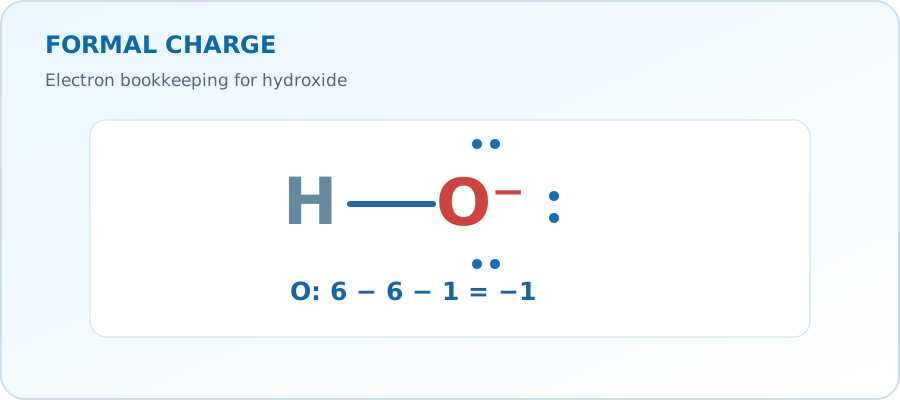
Each lone pair on the atom contributes two nonbonding electrons. Do not count another atom’s dots. For an oxygen atom with three lone pairs, the nonbonding electron count is six.
OH⁻ oxygen: V=6; nonbonding=6; bond order=1.
3. Add bond orders
Single, double, and triple bonds contribute 1, 2, and 3 to the bond-order total. This is a bookkeeping rule; it does not say bonding electrons belong exclusively to one atom.
OH⁻ oxygen: FC = 6 − 6 − 1 = −1.
4. Check the overall charge
Sum every atom’s formal charge: 0 for a neutral molecule or the stated ionic charge for an ion. A candidate structure with incorrect charge bookkeeping cannot be accepted.
NH₄⁺: N formal charge +1; each H 0; sum +1.
5. Prefer reasonable contributors
When comparing otherwise valid structures, smaller charge magnitudes and negative charge on more electronegative atoms are common guidelines. They are not an automatic algorithm for every species. Formal charge does not equal a measured partial charge.
In CO, a common octet-satisfying structure is :C≡O: with C −1 and O +1.
Common mistakes
- Subtracting all shared electrons instead of half of them.
- Calling formal charge the same thing as oxidation state or partial charge.
- Failing to check the charge sum against the formula.
Check your understanding
What is the formal charge on oxygen in H₃O⁺?
Show explanation
O has six valence electrons, two nonbonding electrons, and three bond orders: FC = 6 − 2 − 3 = +1.