
GENERAL CHEMISTRY / BONDING
Lewis Structures: From Electrons to Bonds
Count valence electrons, choose connectivity, and place bonds and lone pairs without inventing electrons.
Learning objectives
- Calculate the correct electron budget for neutral molecules and ions.
- Build a valid structure using bonds, octets, and common exceptions.
- Connect Lewis structures to later geometry and polarity decisions.
1. Count your electron budget
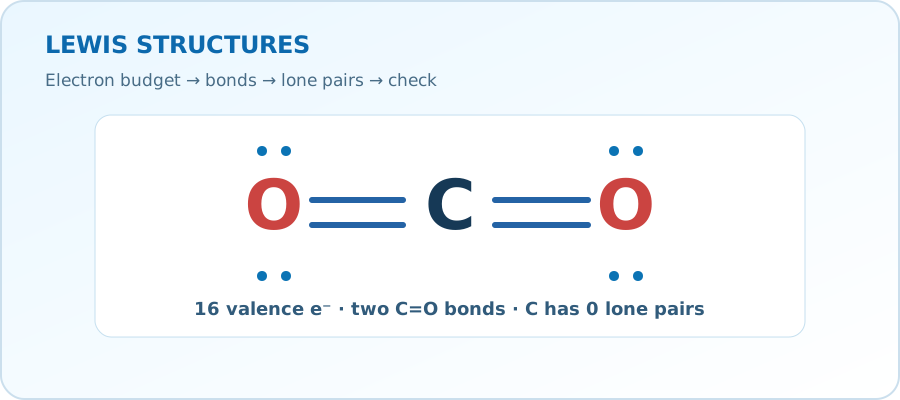
Add valence electrons from all atoms. Add one electron for each unit of negative charge, or subtract one per unit of positive charge. For CO₂, carbon contributes 4 and two oxygen atoms contribute 12: total 16.
CO₂: 4 + 2(6) = 16 valence electrons.
2. Choose connectivity and single bonds
Hydrogen is terminal and forms one bond. Often the least electronegative non-hydrogen atom is central, but common known connectivity and structural exceptions matter. Draw single bonds first; a two-electron bond uses 2 electrons.
For CO₂, start O–C–O: two single bonds use 4 of the 16 electrons.
3. Complete terminal shells and examine the center
Place remaining electrons as lone pairs on terminal atoms (hydrogen only needs two). Then check the central atom. If it lacks an octet, consider a multiple bond made by converting a terminal lone pair into a bonding pair.
CO₂ uses O=C=O, two double bonds, eight electrons around C.
4. Check formal charge and exceptions
Verify that total electrons are accounted for, every appropriate octet is satisfied, and formal charges sum to the species charge. BF₃ is an electron-deficient compound: neutral B commonly has only six electrons in its three B–F bonds. Do not force every element into an octet.
BF₃: 3 + 3(7) = 24 electrons; neutral boron has three bonds and an incomplete octet.
5. Practice a second example
For NH₃, total valence electrons are 5 + 3 = 8. Three N–H single bonds use 6; the remaining two electrons form one lone pair on nitrogen.
NH₃ has three bonded neighbors plus one lone pair on the N atom.
Common mistakes
- Counting bonds as one electron rather than two.
- Giving hydrogen an octet or forcing boron in BF₃ to have eight.
- Confusing the number of bonded atoms with the number of bonding electrons.
Check your understanding
In the normal Lewis structure of H₂O, how many lone pairs are on the central oxygen?
Show explanation
Two. Water has eight valence electrons total; after two O–H bonds, four electrons remain as two lone pairs on O.