
INTOCHEMISTRY / UNDERSTAND ELECTRON FLOW
E2: Concerted Elimination
Use beta-hydrogen geometry and three simultaneous electron-flow arrows to form alkenes.
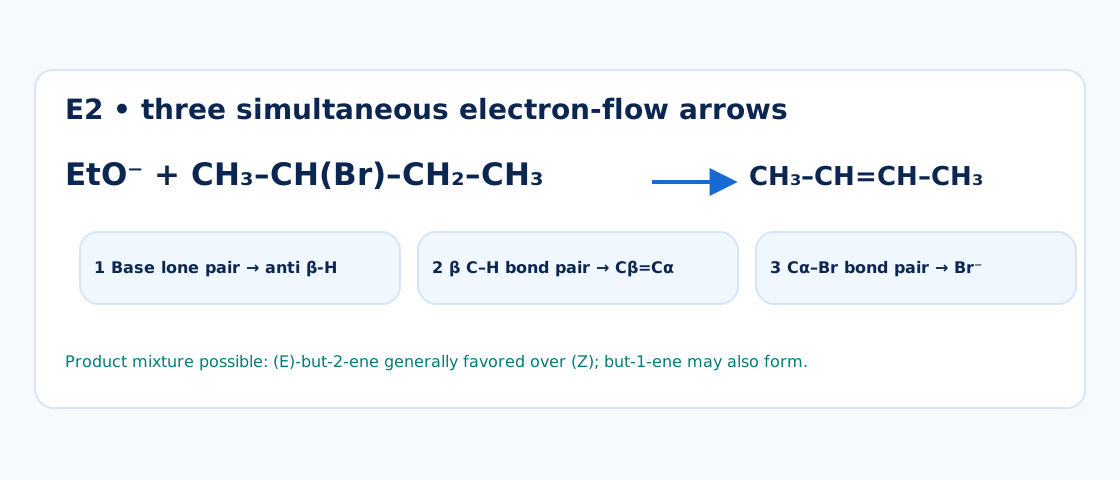
Identify an accessible beta hydrogen, draw all three E2 arrows, and predict regioselectivity with appropriate qualifications.
1The key idea
E2 is one elementary step: a base removes a beta hydrogen while the adjacent C–H bond electrons make a carbon–carbon pi bond and the leaving group departs. No carbocation forms.
2The three curved arrows
Arrow 1: lone pair of the base to a beta hydrogen. Arrow 2: beta C–H bond to the adjacent Cβ–Cα bond. Arrow 3: Cα–leaving group bond to the leaving group. All three arrows are concerted.
3Anti-periplanar requirement
The reacting beta C–H and alpha C–leaving group bonds preferably align anti periplanar. For E2 on cyclohexane chairs, the leaving group and beta hydrogen generally must be trans-diaxial.
4Predict the major alkene
A small strong base often favors the more substituted (Zaitsev) alkene when geometrically accessible; bulky bases may favor a less substituted (Hofmann) alkene. Exact product distribution depends on structure, geometry, and conditions.
5Worked example
For 2-bromobutane with sodium ethoxide in ethanol under warm conditions, E2 commonly favors but-2-ene over but-1-ene. Within the but-2-ene fraction, (E)-but-2-ene is generally favored over (Z)-but-2-ene. Do not assume a single exclusive product.
Common mistakes
- Drawing a carbocation intermediate for E2.
- Drawing the attacking base arrow to the carbon rather than the beta hydrogen.
- Leaving out the C–H to C=C arrow.
- Applying Zaitsev’s rule without checking accessible beta hydrogens and anti geometry.
Quick concept check
Which bonds must align anti-periplanar in the preferred E2 transition state?
Show worked explanation
The beta C–H bond and the neighboring Cα–leaving group bond. This alignment enables the needed orbital overlap.