
INTOCHEMISTRY / UNDERSTAND ELECTRON FLOW
SN1: Carbocation Substitution
Learn ionization, nucleophilic attack, and deprotonation as a connected mechanism.
Identify plausible carbocations, use the right electron-flow sequence, and recognize stereochemical mixtures and E1 competition.
1The key idea
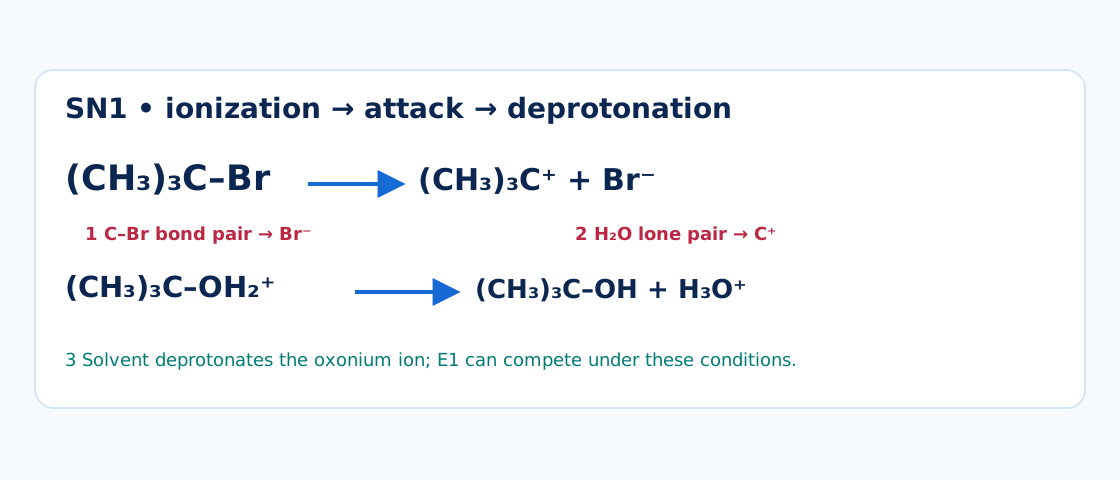
SN1 begins when the leaving group departs heterolytically, producing a carbocation. The carbocation then reacts with a nucleophile. For neutral oxygen nucleophiles, a proton transfer often completes the substitution.
2Where SN1 is plausible
Tertiary and some benzylic or allylic substrates can form relatively stabilized carbocations. Polar protic solvents facilitate ionization; weak nucleophiles such as water or alcohol often participate in solvolysis.
3Draw the ionization first
A curved arrow starts at the carbon–leaving group bond and points to the leaving group. The carbocation left behind is planar at the electron-deficient carbon. A nucleophile attacks in the next elementary step.
4Finish the substitution
If water attacks, the initial product is a protonated alcohol (oxonium ion); a molecule of solvent then removes a proton. The overall pathway may compete with E1 elimination, and the measured product ratio depends on conditions.
5Stereochemistry and rate
Attack on a planar carbocation from either face can reduce stereochemical purity and may give a mixture of configurations; ion-pair effects can prevent perfectly equal product ratios. Rate is commonly first order in the substrate under SN1 conditions.
Common mistakes
- Showing the nucleophile attacking before the leaving group departs in an SN1 mechanism.
- Omitting the deprotonation after neutral water or alcohol attacks.
- Claiming that all SN1 solvolyses produce exactly 50:50 enantiomers.
- Ignoring competing E1 alkene formation.
Quick concept check
Why can SN1 at a stereogenic carbon give both configurations?
Show worked explanation
The leaving group departs to make a planar carbocation that can be approached from more than one face, although ion pairs may influence product ratios.