
INTOCHEMISTRY / UNDERSTAND ELECTRON FLOW
SN2: One-Step Nucleophilic Substitution
Follow electron pairs from nucleophile to electrophilic carbon and out to the leaving group.
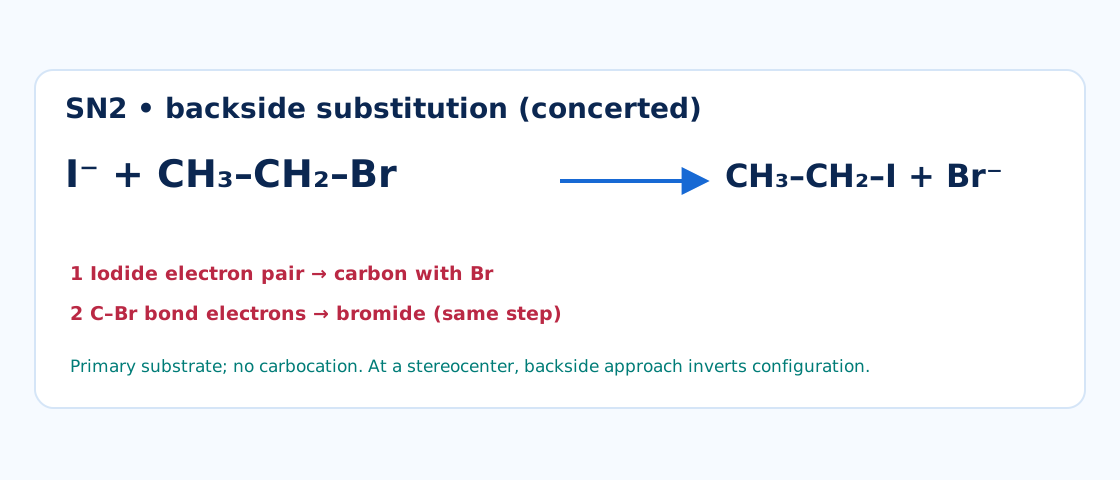
Predict when backside substitution is favored, draw the two simultaneous arrows, and describe stereochemical inversion.
1The key idea
SN2 is a concerted substitution: a nucleophile forms a bond to the carbon bearing the leaving group while the carbon–leaving group bond breaks. No discrete carbocation is formed.
2When to choose SN2
Methyl and unhindered primary substrates are especially favorable. Strong nucleophiles in polar aprotic solvents often support SN2; secondary substrates can work when the nucleophile is not too basic or hindered. Tertiary alkyl halides are not suitable SN2 substrates.
3Draw curved arrows correctly
Begin an arrow at the nucleophile’s electron pair and end it at the electrophilic carbon, not at the leaving group. A second arrow begins at the carbon–leaving group bond and ends at the leaving group. Both arrows belong to the same elementary step.
4Stereochemistry and rate
Backside attack inverts the three-dimensional arrangement at the reactive carbon. If substituent CIP priorities are unchanged, an R configuration becomes S and vice versa; check priorities rather than assuming the letter always flips. Rate = k[RX][Nu].
5Worked example
Bromoethane + iodide ion in acetone gives iodoethane + bromide ion. Iodide attacks the carbon bearing bromine, and the C–Br bond breaks in the same step. SN2 is favored for the primary carbon; acetone is polar aprotic.
Common mistakes
- Drawing a carbocation as an SN2 intermediate.
- Starting the attacking arrow at the positively polarized carbon instead of at the nucleophile.
- Calling every inversion an R-to-S label change without checking CIP priorities.
- Treating all strong nucleophiles as weak bases (some also promote E2).
Quick concept check
Does SN2 on a chiral carbon produce inversion or retention of its spatial configuration?
Show worked explanation
Backside attack gives inversion at that carbon. The absolute R/S label depends on CIP priorities before and after substitution.