
INTOCHEMISTRY / STEREOCHEMISTRY
SN2 Inversion and Product Configuration
Separate the geometry of backside displacement from an R/S label.
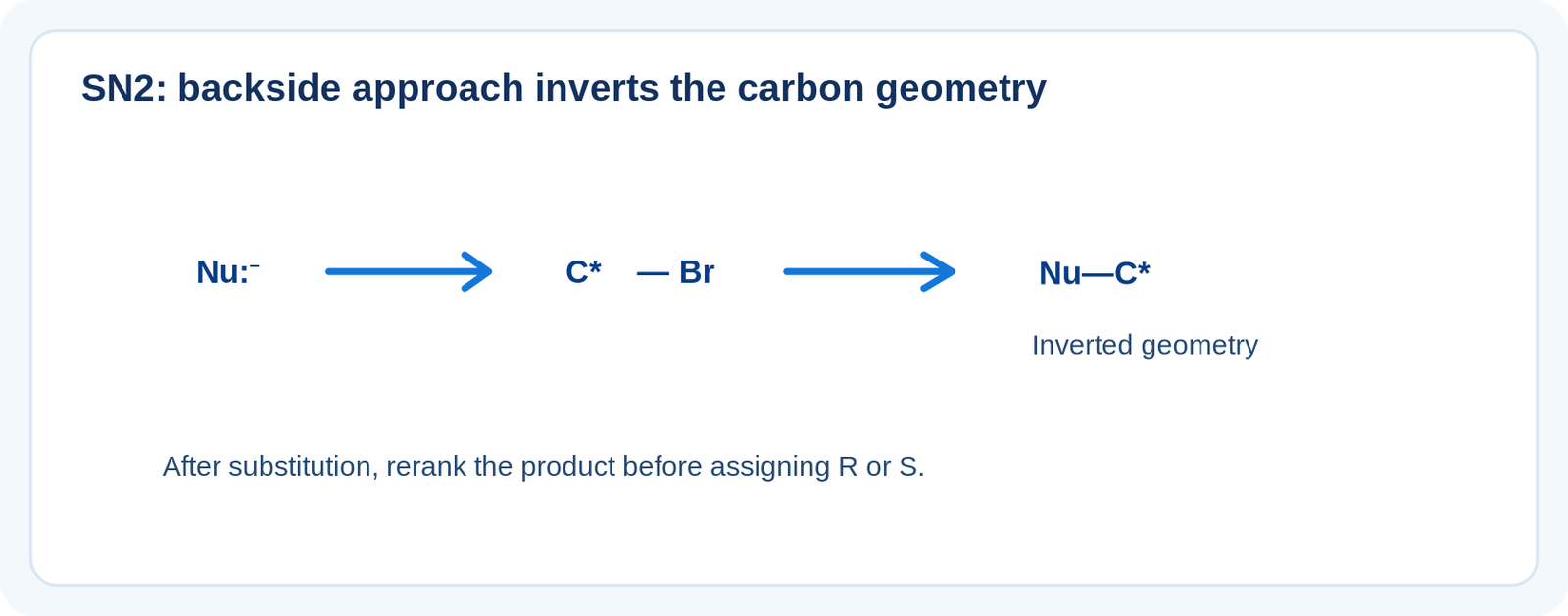
Predict backside inversion and reassign CIP priorities after substitution.
1Backside displacement
SN2 is a concerted pathway: a nucleophile attacks the electrophilic carbon opposite the leaving group as the C–leaving-group bond breaks.
2What inverts?
The tetrahedral arrangement of the three unchanged substituents around the reactive carbon is inverted. This is inversion of geometry at that carbon.
3Recalculate configuration
R and S depend on ranking substituents in each molecule. If replacement changes priority order, an inverted carbon need not undergo an R → S or S → R change in its written label.
4Worked example
Under SN2-favoring conditions, (S)-2-bromobutane with hydroxide can give (R)-2-butanol because both Br and OH take first CIP priority, while the original three groups keep their order.
5Competing pathways
A secondary substrate may also eliminate, especially with strong base and warmer conditions. The worked example isolates the substitution product, not a guaranteed exclusive outcome.
6Common error
Do not call SN2 racemization. It is stereospecific inversion at the carbon being substituted, when the reaction proceeds by that pathway.
Concept check
Does SN2 always switch the R/S name?
Reveal explanation
No. SN2 produces inversion at the carbon, but the R/S descriptor must be determined from the product’s CIP rankings.