
Regioselective Alkene-to-Alcohol Synthesis
Choose hydration conditions that place OH on the correct carbon.
Learning objective
Distinguish Markovnikov from anti-Markovnikov alcohol targets.
1Read the alkene
Locate both alkene carbons and determine whether they are equivalent. For a symmetric alkene, a regioselectivity distinction may be irrelevant.
2Markovnikov alcohols
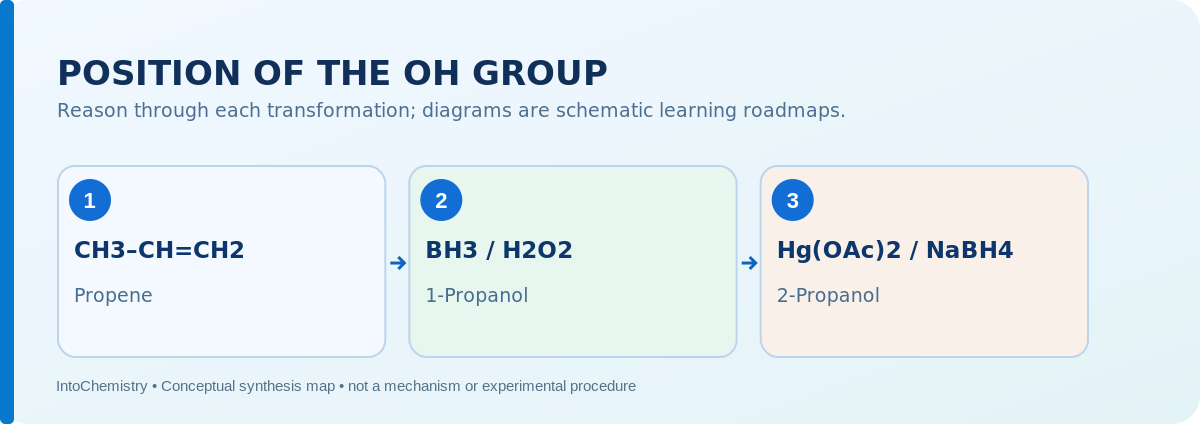
Oxymercuration–demercuration is a common route to Markovnikov alcohols without free-carbocation rearrangements: Hg(OAc)2/H2O followed by NaBH4.
3Anti-Markovnikov alcohols
Hydroboration–oxidation (BH3·THF then H2O2/NaOH) places OH at the less substituted position; H and B add syn in the hydroboration step.
4Watch stereochemistry
A new stereocenter formed from an achiral planar alkene may give an enantiomeric mixture; do not present an unlabelled wedge/dash drawing as a single exclusive stereoisomer.
5Worked example: 1-butene to 1-butanol
A terminal primary alcohol requires anti-Markovnikov hydration; use hydroboration–oxidation instead of oxymercuration–demercuration.
Check your understanding
Which pathway places OH on carbon 1 of propene?
Reveal explanation
Hydroboration–oxidation gives 1-propanol. Oxymercuration–demercuration gives 2-propanol.