
Ether Synthesis & SN2 Disconnections
Select the alkoxide and halide partners to avoid poor SN2 pathways.
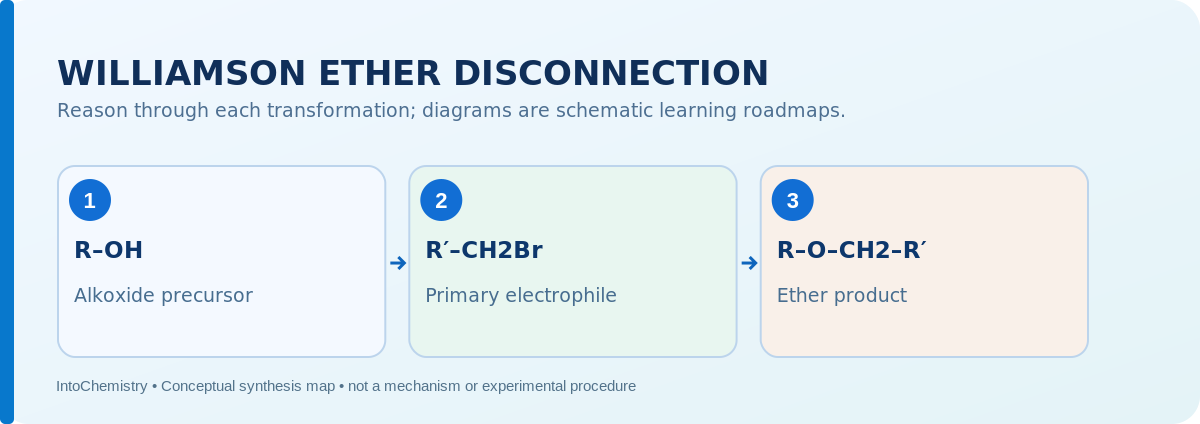
Learning objective
Plan Williamson ether syntheses and recognize E2 competition.
1Disconnect across oxygen
Identify two alkyl groups connected to ether oxygen and evaluate which C–O bond could be made by SN2.
2Place the leaving group wisely
Methyl and primary alkyl halides are usually best SN2 electrophiles. Tertiary electrophiles favor elimination with strong alkoxides.
3Prepare the alkoxide
A suitable alcohol can be deprotonated with an appropriate base before adding the alkyl halide. State the actual order of reagents.
4Consider hindered alkoxides
A bulky alkoxide attacking methyl iodide may still undergo SN2 at methyl carbon. Bulky nucleophiles paired with secondary electrophiles invite E2 competition.
5Worked example: phenol to anisole
Form phenoxide using mild base and methylate with CH3I; substitution happens at the methyl carbon, not directly at aromatic sp2 carbon.
Check your understanding
Why does methoxide plus tert-butyl bromide generally fail as a Williamson ether plan?
Reveal explanation
An SN2 displacement at tertiary sp3 carbon is strongly hindered; E2 is strongly favored with an alkoxide. Use a methyl or primary electrophile instead.