

There is alcohol in space. Not in a cosmic cocktail glass, of course: scientists have found evidence for ethanol and other organic molecules in extremely cold icy material surrounding young stars. Even more impressive, the molecules were identified without anyone traveling there to collect a sample.
The discoveries show how chemistry can occur in environments that seem impossibly distant and cold. They also provide a dramatic connection between the infrared spectroscopy used in chemistry laboratories and the instruments on the James Webb Space Telescope.
What Exactly Did Scientists Find?
In March 2024, NASA reported that Webb’s Mid-Infrared Instrument (MIRI) had detected multiple molecules in interstellar ices near two young protostars, IRAS 2A and IRAS 23385. Among them were ethanol (C₂H₅OH) and evidence consistent with acetic acid (CH₃COOH), together with simpler compounds such as methane and formic acid. NASA described the acetic-acid identification as likely, reflecting a difference in confidence among assignments.
These observations matter because the protostars are at early stages of development, before their planets have formed. Detecting organic compounds in ices helps researchers understand possible chemical inventories of star-forming regions and how molecules might later be incorporated into comets, asteroids, or developing planetary systems.
Explore the original announcement and NASA’s accompanying astronomical observations: Webb Finds Ethanol and Other Icy Ingredients for Worlds.
How Can Light Reveal the Identity of a Molecule?
All molecules interact with electromagnetic radiation in specific ways. Infrared radiation can excite molecular vibrations, such as stretching and bending of bonds. The position, intensity, and shape of an absorption band depend on bond strength, atomic masses, molecular structure, and environmental conditions.
For example, carbonyl-containing compounds often exhibit characteristic C=O stretching absorption, while compounds with O–H groups can display O–H stretching features. However, an individual band is rarely unique to a single molecule. Scientists look for a combination of features that matches laboratory reference spectra and physically reasonable models.
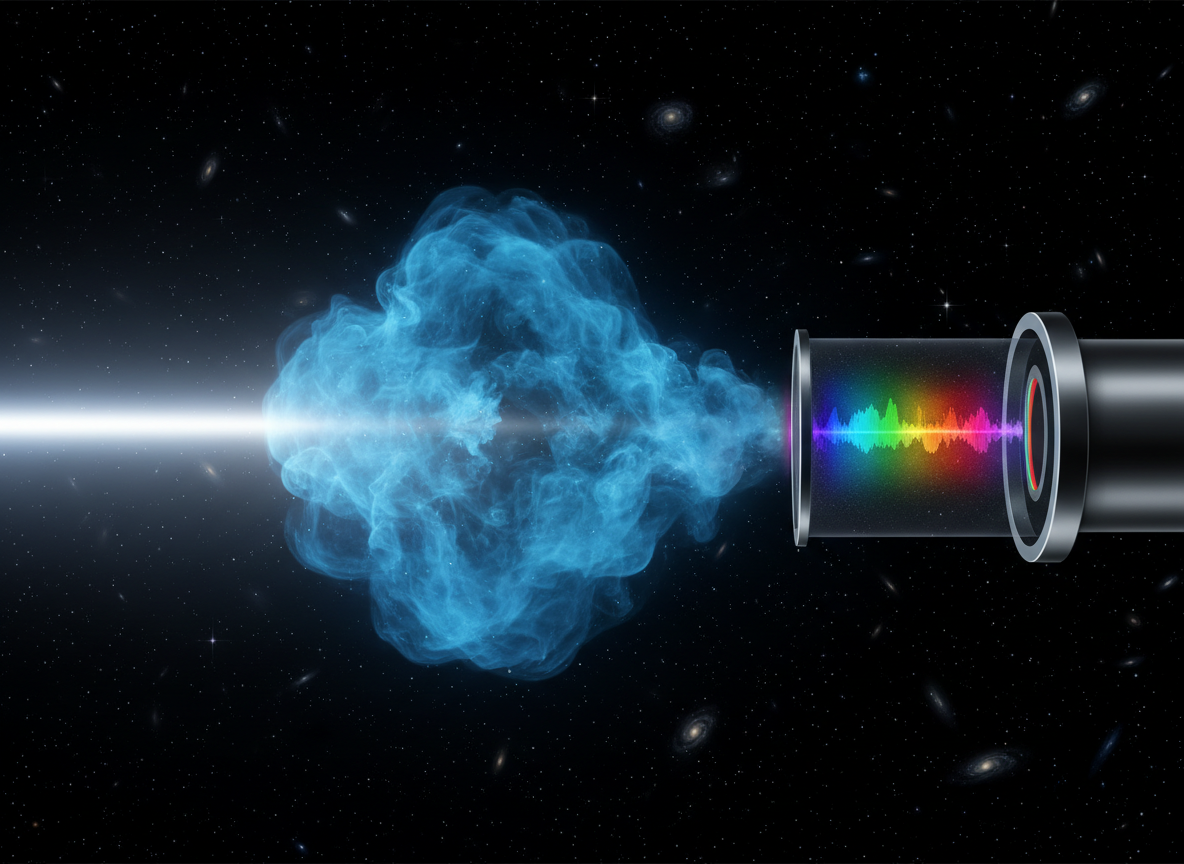
The Surprising Connection to Organic Chemistry Lab
If you’ve interpreted an infrared spectrum in organic chemistry, you’re using principles closely related to those employed in astrochemistry. In an ordinary laboratory, the sample might be an organic liquid measured by ATR-IR, a thin film, or a gas. In an astronomical observation, the sample might be an ice mixture surrounding dust grains illuminated by background radiation.
To explore the connection, visit the NIST Chemistry WebBook and locate infrared data for ethanol and acetone. Identify regions that help you distinguish alcohol and carbonyl groups. Then ask how temperature, phase, hydrogen bonding, and mixture composition could change spectral appearance.
A key caution: Peaks measured in a cold solid mixture cannot always be matched one-to-one with peak positions measured for a warm gas or liquid. Responsible spectral assignments use references appropriate to the environment and account for overlapping absorptions.
From Protostars to Exoplanet Atmospheres
Webb has also identified carbon dioxide in the atmosphere of the exoplanet WASP-39 b. As the planet transits its host star, some of the starlight passes through the atmosphere. Molecules absorb particular wavelengths, leaving a wavelength-dependent signature in the measured light.
The resulting transmission spectrum contains a prominent feature near 4.3 micrometers consistent with CO₂. NASA provides an annotated WASP-39 b spectrum, which is a fascinating real data example for students studying electromagnetic radiation and molecular spectroscopy.
Why Do Organic Molecules Form in Space?
Astrochemical researchers investigate whether molecules form directly in the gas phase, on dust-grain surfaces, or within ice layers. Cold dust-grain ices can supply conditions where simpler species react and accumulate more complex products. Radiation, energetic particles, warming, and subsequent sublimation can all affect what is detected.
The 2024 findings are evidence relevant to the idea that some complex organics form in cold ices and can later enter warmer regions. They do not establish that every detected molecule formed by a single route.
Does Finding Organic Molecules Mean Scientists Found Life?
No. The word organic describes a broad family of carbon-containing compounds—not necessarily substances made by living organisms. Organic molecules can form through nonbiological reactions. Their detection may reveal prebiotic chemical possibilities, but it is not proof of organisms, habitable conditions, or life.
Astronomers aren’t simply looking for a molecule that fits one peak. They’re asking which chemical explanation best matches all the evidence.
Three Astrochemistry Challenges
- Challenge 1 — Bond identification: Which IR features would help distinguish an alcohol from a ketone? Could one broad band settle the question?
- Challenge 2 — Compare environments: Why might the IR spectrum of ethanol in an interstellar ice differ from a room-temperature laboratory measurement?
- Challenge 3 — Evidence and inference: Does detecting ethanol around a protostar guarantee it will later appear on a planet? Explain the missing steps.
Where to Explore Next
Browse the PubChem structures of ethanol, acetic acid, and methanol; compare their formulas and functional groups. Read the NASA source article and see the actual observed spectrum. For more accessible explorations of molecular structure and measurements, visit IntoChemistry or our caffeine extraction guide.