
Carbonyl Chemistry Exam Review
Differentiate addition, oxidation, reduction, esterification and acyl substitution.
1. Understand the Concept
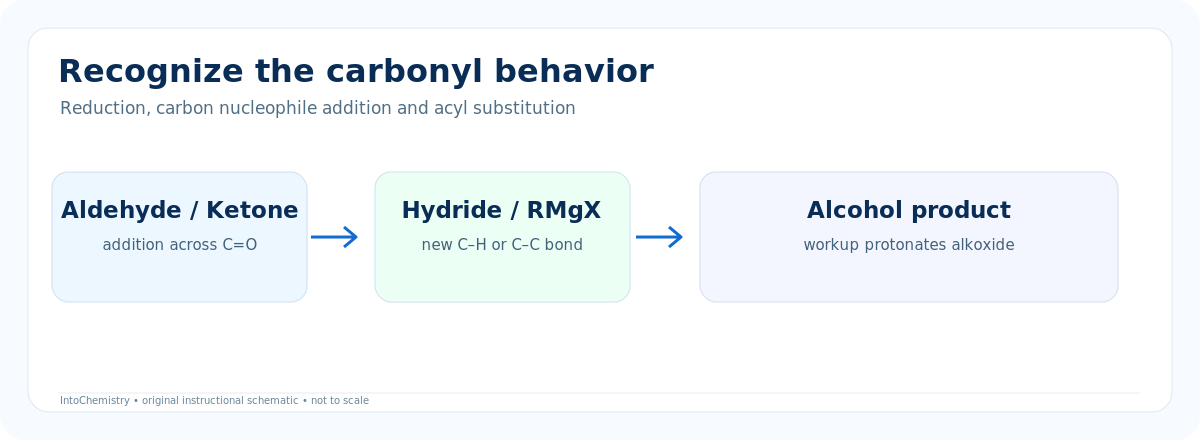
Aldehydes and ketones usually undergo nucleophilic addition at the carbonyl carbon. Acyl derivatives have a leaving group at that carbon and can undergo nucleophilic acyl substitution.
Your goal: Differentiate addition, oxidation, reduction, esterification and acyl substitution.
2. Step-by-Step Exam Strategy
Ketones, aldehydes, esters, acyl chlorides and amides react differently.
NaBH₄ adds hydride to ketones and aldehydes; PCC typically oxidizes anhydrous primary alcohol to aldehyde.
Nucleophiles add to C=O; a good leaving group can be expelled in acyl substitution.
Hydride addition requires protonation; Fischer esterification is reversible and acid-catalyzed.
3. Visual Reference
4. Worked Example
Propanone + NaBH₄; then water
Hydride adds to the carbonyl carbon, producing an alkoxide that is protonated to propan-2-ol. The carbonyl becomes a secondary alcohol.
5. Common Mistakes
- Treating a ketone as if it contains a leaving group that is expelled.
- Assuming PCC and strong aqueous chromium oxidants give identical products from primary alcohols.
- Forgetting acidic workup after Grignard addition.
6. Practice & Reinforcement
Try the interactive questions below. In Practice mode, each answer includes an explanation. In Mock Exam mode, explanations appear after submitting the full set.
Interactive questions load when JavaScript is available. Download the printable study sets for offline review.